Patching up pandemic preparedness: a needle-free approach to influenza vaccination
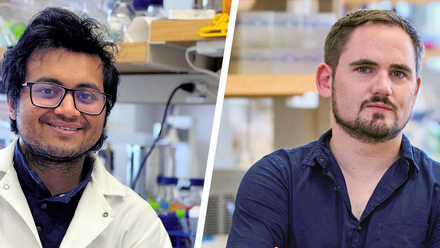
Chris McMillan and Chloe Entriken of the University of Queensland, Australia, take us behind the scenes of their latest publication 'Improved efficacy of an influenza DNA vaccine through high-density microarray patch delivery' published in the Journal of General Virology.
My name is Chris McMillan, and I am a Research Fellow in the School of Chemistry and Molecular Biosciences at the University of Queensland, Australia. My research focuses on developing new vaccines and, importantly, new ways to deliver them.
One technology our lab has been exploring is the high-density microarray patch, or HD-MAP – a technology being commercialised by UQ spin-out company Vaxxas Pty Ltd. Imagine a small patch covered in thousands of tiny projections, each shorter than a millimetre. When pressed against the skin using a spring-loaded applicator, these microprojections deliver the vaccine directly into the skin layers, which happen to be packed with immune cells. No needles required.
This approach offers some exciting advantages. MAP-delivered vaccines can produce stronger immune responses than traditional injections, potentially allowing us to use lower doses while achieving the same protection. The HD-MAP vaccines are also remarkably stable, removing the need for cold chain storage that can be a major barrier in remote or low-resource settings. And because they are so simple to use, even untrained individuals can self-administer them.
In our latest paper, published in the Journal of General Virology and led by student Chloe Entriken, asked whether we could use the HD-MAP for delivery of DNA vaccines for pandemic preparedness. DNA vaccines are similar to mRNA vaccines, encoding genetic instructions for a vaccine antigen, which then triggers an immune response. Relative to mRNA vaccines, they are cheap, quick to manufacture, and incredibly stable. In theory, they should be perfect for pandemic responses. However, when delivered by traditional injection with a needle and syringe, DNA vaccines just do not work very well in humans unless you use complex approaches like electroporation, a process that uses electrical pulses to help cells take up the DNA.
We wondered whether delivering DNA vaccines via the HD-MAP might overcome this limitation. Using a DNA vaccine encoding either a luciferase reporter or the haemagglutinin protein from the 2009 H1N1 pandemic influenza strain as an example pandemic virus, we compared MAP delivery to standard intramuscular injection in mice.
Using the luciferase reporter, we could actually see that the MAP-delivered DNA was expressed earlier and at much higher levels in mice than the injected version. When we looked at the immune response to our influenza vaccine, HD-MAP vaccination induced strong antibody responses against the influenza protein, while injection of the same dose essentially failed to generate any meaningful response. Most importantly, when we challenged the mice with live H1N1 virus, every single MAP-vaccinated mouse was completely protected. In contrast, half of the mice that received the vaccine by injection reached humane endpoints and had to be euthanised.
We chose influenza for this work because it represents one of our most significant pandemic threats. The ongoing H5N1 outbreaks in US dairy cattle and wild mammals are a stark reminder that the next influenza pandemic is not a matter of if, but when. Having rapid-response tools in our toolkit is essential, and the combination of DNA vaccines with MAP delivery could be exactly that.
Of course, these are mouse studies, and we know that findings in mice do not always translate directly to humans. My hope is that we can progress this work into clinical trials, where we can determine whether the same benefits hold true in people. If they do, this approach could be extremely beneficial for our pandemic preparedness.
More broadly, I think we should be excited about the future of vaccination. The needle and syringe has served us well for over a century, but technologies like MAPs have the potential to make vaccination easier, more effective, and accessible to more people around the world. That is something worth working towards.