
South Asian Heritage Month: Deepali Luthra
Growing up
I grew up in Saharanpur, a small city in Uttar Pradesh, India, not a place most people associate with cutting-edge biological research. What it offered instead was curiosity, discipline and the quiet conviction that education could open doors. With the best my parents could provide, they enrolled me in a convent school, where perseverance and integrity were threaded into everyday learning. Biology soon became the subject I looked forward to most. I could not have known then that the microbes in my textbooks would one day shape a career across three continents, only that I wanted to understand how invisible organisms could have visible consequences for human health.
First steps in research
That curiosity led me to undergraduate study in microbiology at Panjab University, India, and then to a master’s degree at Punjab Agricultural University in Ludhiana, India: my first true immersion in research culture. Long hours in the laboratory, experiments that refused to cooperate, and the satisfaction of solving problems that mattered beyond the bench defined those years. Working with my supervisor, Dr Param Pal Sahota, I helped develop a Bacteriological Food Testing Kit (BFTK) for rapid detection of foodborne pathogens in raw food. Watching the project move from bench to validation, and eventually to a granted patent, shaped my understanding of what microbiology could achieve. The kit was later implemented in rural India at a cost of roughly one dollar per test, a moment I describe as among the most meaningful of my career, confirming that rigorous science can also be affordable and accessible.
During the long stretches of troubleshooting that project, Dr Sahota offered advice I have carried ever since: "Research is research; keep exploring until it reveals a clear path." I have returned to those words throughout my career during my PhD, through visa uncertainty, and in the slow periods when progress felt invisible. Patience, persistence and curiosity, I note, have mattered as much as any technique learned at the bench.
Moving to the United States
After a year as a Senior Research Fellow at CSIR - Institute of Microbial Technology in Chandigarh, India, I moved to the United States to pursue a PhD in Microbiology and Molecular Genetics at Oklahoma State University, USA. Leaving home was not straightforward. Like many international scientists, I navigated cultural adjustment, distance from family and the practical pressures of building a life far from where I started. I also found community among fellow international students, within my university, and in the broader microbiology networks that would become central to my professional life.
My doctoral research examined how calcium influences host–pathogen interactions between Pseudomonas aeruginosa and lung epithelial cells, with direct relevance to cystic fibrosis airway disease. What began as a molecular biology question became a thread I followed for years: how the host immune environment shapes, and is shaped by, persistent bacterial infection. Those years tested my resolve but also confirmed what I had sensed since Ludhiana: that I am most fulfilled when research sits at the interface of basic science and human disease.
Postdoctoral research at Emory Medicine
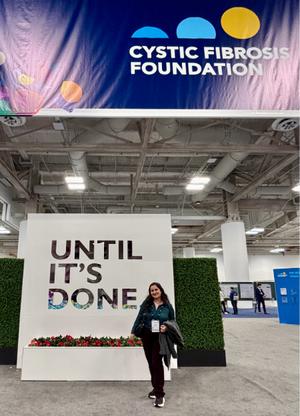
To broaden my commitment to translational science and paediatric rare diseases, I completed a postdoctoral fellowship at Emory University School of Medicine, USA, with Dr Rabindra Tirouvanziam at the Department of Pediatrics and Center for Cystic Fibrosis and Airways Disease Research. There, I investigated how neutrophils, and other immune cells, adapt to the cystic fibrosis lung microenvironment, mechanisms that can paradoxically promote bacterial tolerance rather than clearance. I also contributed to a clinical collaboration on immune mediator profiles in diabetic foot ulcers, connecting bench science to patient sample outcomes in real time. Through the Cystic Fibrosis Scholars programme, I worked alongside clinicians and patient families to better understand the intricacies of complex immunomodulatory pathways in humans. I came to see research not as something done for patients in the abstract, but with an awareness of the lives behind every sample.
Joining Stanford Medicine
Earlier this year, I joined Stanford University, School of Medicine as a Research Scientist in the Department of Pediatric Hematology, Oncology, Stem Cell Transplantation and Regenerative Medicine, USA. My current work focuses on immunological mechanisms underlying inhibitor development in haemophilia and related bleeding disorders, yet another turn in a career that has moved from food safety in Punjab, India, to airway infection in Oklahoma and Georgia, USA, and now to immune tolerance at one of the world's leading medical center’s in California, USA. The science changes; the through-line does not. I seek to understand how the immune system decides friend from foe and how research might intervene when that decision goes wrong, helping science move from bench to bedside.
A home in the Microbiology Society
This body of work contributed to me receiving a travel fellowship from the Novo Nordisk Foundation, which took me to Copenhagen and strengthened my connection with the Microbiology Society. Throughout my career, I have found that unity in diversity is not an abstract idea but the structure of my professional life. Educated across India and the United States, now working in California while maintaining ties to scientific communities in Europe and the UK, I have found that unity comes not from sameness, but from shared purpose: a commitment to rigorous science, mentorship, and making microbiology accessible and meaningful beyond the laboratory.
The Microbiology Society has played an important part in that sense of belonging. Since becoming a Society Champion two years ago, I have connected with microbiologists across borders, fostering collaborations between the US and Europe, participating in Society activities and building a global community of peers, who share a passion for the field. Receiving the Novo Nordisk Foundation Fellowship through the Society's partnership was a particular highlight, reinforcing that support for early- and mid-career researchers can come from networks as much as from individual institutions. For someone who has built a career across countries and scientific disciplines, finding a professional home within the Society has been genuinely grounding.
Mentorship and role models
Mentorship remains central to how I hope to give back. I have supervised students across microbiology, immunology, oncology, anthropology and nutrition — co-designing experiments, celebrating their first conference presentations and watching them grow into independent budding scientists. Leadership, I have learned, is less about directing and more about cultivating trust: when people feel heard and empowered, they take ownership of their work and elevate the entire team. That principle guides me whether I am mentoring an undergraduate in the laboratory or connecting early-career researchers through Society networks.
Among my role models are the mentors who shaped my scientific thinking, such as Dr Sahota and Dr Tirouvanziam, but also the family members who supported my education before its full shape was clear. I am inspired by senior scientists from South Asian backgrounds who have built distinguished careers while championing inclusion within the field, including Professor Gurdyal Besra, whose journey from Birmingham to the Presidency of the Microbiology Society offers a reminder that background is not an obstacle to excellence, but part of what scientists bring to the table.
Advice for early career researchers
For those from similar backgrounds who are working, or hoping to work, in science, my message is straightforward: ‘Control your effort, not the outcome. Give your best every time.’
Plan early, especially around visa timelines and career transitions, which carry added pressure for international researchers. Build your network deliberately; the right people in the right environment will help you grow, and you can pay that forward. Stay curious even when the path is unclear. Diversity within South Asian communities, and within science itself, is a strength. Unity does not require uniformity. Some of the most exciting science happens at the intersections between clinical and basic research, and between countries and cultures.
My journey has been neither linear nor predictable. I feel grateful and humbled to reflect on where I come from and what I have been able to contribute, while knowing how much remains to be done. Shaped by grit, mentorship and a field that continues to surprise and challenge me, I hope that sharing my story during South Asian Heritage Month, and its 2026 theme ‘Unity in Diversity’, will encourage even one more person to see themselves in microbiology.
If you are interested in growing your network via Society activities, like Deepali has, find out more via our Get Involved hub.