
AMR Graphic Novels Project
A quick introduction of the team and the project
The AMR Graphic Novels project brings together colleagues from microbiology, education and the arts to explore new ways of engaging people with one of the most important global health challenges of our time: antimicrobial resistance (AMR). The Graphic Novel project is a genuinely cross-disciplinary collaboration between three educators with different areas of expertise.
Dr Michael Shaw, a Senior Lecturer at the University of Lincoln with a background in molecular microbiology has a particular interest in inclusive and digital pedagogies. Alongside teaching and research, Michael has previously presented work on digital approaches to AMR education at Microbiology Society conferences and is a member of the Society’s Education and Outreach Network.
Dr Nicola Crewe, Senior Lecturer in Food Microbiology, is a microbiologist whose expertise spans food microbiology, molecular biology in the food industry, UKAS accreditation and educational innovation. Nicola is also a member of the Microbiology Society’s Education and Outreach Network and has been passionate about finding creative ways to make microbiology education more engaging and accessible.
Completing the team is Mark Leary, Course Lead for Graphics and Illustration at Lincoln College of Art and Design. Mark brings more than 20 years of professional experience in artwork and design, alongside expertise in educational practice and visual communication. His current PhD explores how visual media and aesthetic experience can be used in education, making him ideally placed to help translate complex scientific ideas into compelling visual narratives.
What is AMR Graphic Novels?
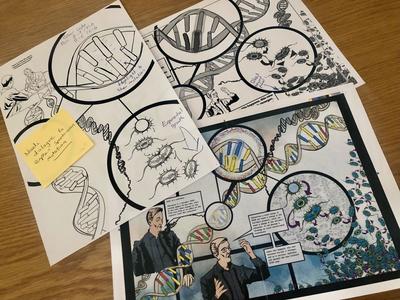
AMR Graphic Novels is a cross-disciplinary education and outreach project that uses visual storytelling to communicate the science and importance of antimicrobial resistance (AMR) in a way that is engaging, accessible and memorable.
The idea emerged from a shared interest in education, microbiology and visual communication. As a team, we wanted to explore whether graphic novels could help bridge the gap between scientific knowledge and public understanding by presenting complex concepts through narrative, characters and illustrations. Rather than relying solely on traditional science communication formats, we wanted to create resources that would spark curiosity and encourage people to engage with AMR in a different way.
Our first issue of the graphic novel, The Invisible War, helps to explain how antibiotic resistance occurs and why AMR represents a growing global challenge. By combining accurate scientific content with professional illustration and storytelling, the graphic novel aims to make difficult concepts easier to understand without oversimplifying the science.
A key feature of the project is collaboration; each chapter involves really effective teamwork. This allows us to ensure that the science is accurate, the educational design is effective, and the visual narrative is engaging. We see this as a great example of how different disciplines can contribute unique perspectives to tackling complex challenges such as AMR.
More broadly, the project is about experimenting with innovative approaches to AMR education. Graphic novels offer a powerful way of combining visual communication with narrative, helping readers connect with scientific ideas on both an intellectual and emotional level. We hope the resources increase understanding of AMR and that they also inspire conversations and encourage more people, not just those interested in science, to take an interest in microbiology and the role it plays in addressing global health challenges.
You have made sure this is a free-to-access resource, what was your thinking behind this, and why are accessible educational tools so important?
From the very beginning, we wanted the AMR Graphic Novels project to be as open and accessible as possible. Antimicrobial resistance is a global challenge that affects everyone, so it felt important that the educational resources we create should be available to everyone too.
One of our core principles has been removing barriers to access. That's why we have made the graphic novels freely available through Creative Commons licensing. We had heard from teachers that they had challenges finding high-quality resources that can be adapted and used in different contexts, whether that's a school classroom, a university lecture, a public engagement event or independent learning. By openly sharing the novels, we hope other educators can use, adapt and build upon the materials in ways that suit their own learners and settings.
More broadly, we see this as part of a wider commitment to open education. Knowledge has the greatest impact when it can be shared widely, and challenges such as AMR require a collective response. If educational resources remain behind paywalls or restrictive licensing arrangements, their potential reach and impact are inevitably limited. Making the novels freely available helps support wider conversations about AMR and encourages educators from different disciplines to engage with the topic.
Accessibility is equally important. We want our resources to be usable by as many people as possible. Throughout the project we've thought carefully about how different learners might experience the graphic novels and what barriers could prevent engagement. Graphic novels are often seen as highly visual resources, but that can create challenges for readers who use assistive technologies or who access content in different ways.
As a result, we've invested considerable effort in ensuring the digital versions are accessible. This has included developing accessible PDF formats, providing meaningful alternative text, improving document structure for screen readers and thinking carefully about how visual information is communicated. Accessibility must not be an afterthought added at the end of a project; it should be built into the design process from the start.
Ultimately, the goal is simple: if we're serious about improving understanding of antimicrobial resistance, then we need educational resources that are open, inclusive and easy to access. Making the graphic novels freely available and designing them with accessibility in mind is our way of helping ensure that as many people as possible can take part in that conversation.
How did the idea come about?
The project started with a simple question: could graphic novels help us communicate antimicrobial resistance more effectively?
Both Nicola and Michael have backgrounds in microbiology, but we also share a strong interest in educational innovation and public engagement. Through our involvement with the Microbiology Society’s Education and Outreach Network, we had spent a lot of time thinking about how we could reach audiences beyond traditional lectures, scientific papers and awareness campaigns.
The project really took shape when we started collaborating with Mark Leary. Mark brought expertise in illustration, design and visual media, alongside a background in how visual experiences can support learning. What began as an informal conversation between colleagues from different disciplines quickly developed into a genuine collaborative project. In fact, the project started over coffee and cake, and, in many ways, that is still how it operates today. Some of our best ideas, story developments and creative discussions have emerged from regular catch-ups over coffee, where we could openly explore ideas from our different disciplinary perspectives.
In many ways, the project itself reflects one of the key messages we often share about AMR: solving complex problems requires people with different expertise working together. The AMR Graphic Novels project grew from exactly that kind of collaboration, bringing together scientists, educators and creative practitioners around a shared goal of making AMR education more accessible, engaging and impactful. And, thankfully, it continues to be fuelled by plenty of coffee and cake.
In the Novel you have created striking imagery and storytelling, were these skills already established, a hobby or new for you?
The visual storytelling and artwork all come from Mark's expertise. He's the creative force behind the graphic novels and the person who transforms our scientific ideas into something visually engaging and accessible. With his background in professional illustration and his research into how visual media can support learning, he has an incredible ability to see storytelling opportunities where we are often focused on the science.
Our process is highly collaborative and, much like the project itself, usually starts over coffee and cake. We sit together and discuss the theme of a particular chapter, exploring what the challenge is, why does this problem arise and what is the underlying science? What potential solutions does current research offer, and what challenges still remain?
Mark almost immediately starts visualising how these ideas could become a story. He has a remarkable ability to take what might otherwise be a fairly technical discussion and imagine characters, settings and visual metaphors that can communicate the same concepts in a much more engaging way.
After these discussions, we provide Mark with a short-written briefing, usually a page or two, written intentionally in plain, accessible language rather than scientific jargon. This helps him identify which ideas can be shown visually and which are better communicated through dialogue or narration.
What happens next is always one of the highlights of the process. At the following meeting, Mark typically arrives with an initial line-art draft, and, without exception, we're completely blown away by what he's produced. Even at that early stage, you can already see how the science has been transformed into a coherent narrative. We then work through the draft together, checking for scientific accuracy, refining details and making sure the emphasis is on the most important educational messages.
Mark applies colour, develops the page layouts and refines the visual storytelling through the comic panels. The result is something far greater than the sum of its parts: scientifically rigorous, educationally meaningful and visually compelling.
We think that combination of storytelling, visual communication and scientific accuracy offers something genuinely new for AMR education and outreach.
Tell us about any feedback or anecdotes that has made you realised the impact this has had in supported education around AMR?
At the moment, collecting feedback and evaluation data is actually one of the most important parts of the project for us. We set out to create something innovative, but we also want to understand how educators and students are experiencing the graphic novels in practice and whether they genuinely support learning about AMR.
To help with this, we've distributed printed copies to a range of educators across the UK who have agreed to provide feedback on how they're using the resource and how students respond to it. We're particularly interested in understanding how easily the novels fit into existing teaching programmes, whether they help students engage with AMR concepts, and what improvements we can make in future editions.
The challenge is that the project has attracted considerable interest online as well. The website and digital resources have received a lot of traffic, which is fantastic to see, but it also means there may be many people using the novels whose experiences we're not yet capturing. As educators and researchers, that's both exciting and frustrating, we know the resources are reaching people, but we'd love to hear more about how they're being used.
Although our formal feedback data is still very limited, the responses we've received so far have been extremely encouraging. Educators have told us that the graphic novel was straightforward to integrate into existing teaching activities. We've also heard that undergraduate students appeared genuinely excited to engage with the resource.
We're still at the beginning of the evaluation journey. We would love to hear from more educators and students who have used the graphic novels. If you're using the resource in your teaching, one of the best ways you can support the project is by encouraging students to complete our feedback survey and by sharing your own experiences. The more evidence we can gather, the better we can understand the impact of graphic novels as a tool for AMR education, and education in general, and continue improving the resources for future learners.
One of the biggest lessons from the project so far is that creating the graphic novel was only the first step. Understanding how people engage with it, what inspires them, and how it supports learning is now an equally important part of the story.
What's next for the team and AMR graphic Novel?
We have lots of ideas and, if we're honest, probably more ideas than we have time!
In addition to collecting feedback data, our immediate focus is on Issue 2, which is currently in development. This next instalment will explore themes including antibiotic stewardship, the search for novel antibiotics, and the role of public health education in addressing AMR. As with the first graphic novel, we're aiming to balance scientific accuracy with engaging storytelling and visuals that help readers connect with the issues on both a personal and societal level.
We're also thinking carefully about how we can make the project more accessible to a global audience. AMR is a worldwide challenge, so it's important that resources designed to support understanding aren't limited by geography or accessibility barriers.
We're also beginning to think about what we've learned from this collaboration and how those lessons might help others. One of the most exciting outcomes of the project has been seeing what can happen when scientists, educators and creative practitioners come together around a shared goal. That has led us to start developing plans for a second phase of the project that will focus on helping other researchers communicate their work through visual storytelling and graphic narratives.
It's still early days, but we're incredibly excited by the possibilities. So, watch this space. There is plenty more to come from the team, and we're looking forward to sharing the next chapter of the journey.
Who is this for? And how can people access it?
In short, it's for everyone.
Initially, we developed the graphic novels with education in mind, particularly for use in schools, colleges and universities. Whether you're a student learning about AMR for the first time, an educator looking for engaging teaching resources, a healthcare professional interested in public engagement, or simply someone curious about how antibiotics work and why resistance matters, there's something in the graphic novels for you.
AMR is often described as one of the defining global health challenges of our time, but many people don't encounter the topic until they are studying science or healthcare-related subjects. We wanted to create resources that could help bridge that gap and make the conversation more accessible to a wider audience.
The graphic novels and supporting resources are completely free to access through our project website: AMR Graphic Novels – Engaging learners with antimicrobial resistance through the use of graphic novels.
The website includes digital versions of the graphic novels, project updates, information about our research, accessible resources and opportunities to provide feedback. All of the educational materials are available through Creative Commons licensing, allowing educators to use and share them within their own teaching contexts.
How has the Microbiology Society supported this project?
The Microbiology Society has played a hugely important role in supporting the project and helping us reach educators and learners across the UK.
One of the most significant contributions was through an Education and Outreach Grant, which funded the printing of the first run of Issue 1. While digital resources are incredibly valuable, there is still something special about having a physical copy in your hands. The grant enabled us to print and distribute copies of the graphic novel to colleges and universities across the country.
The Society has also provided opportunities for us to share the project with the wider microbiology and education communities. We presented the work at the Microbiology Society Annual Conference in two different formats. First, through a poster presentation that highlighted the interdisciplinary nature of the project and the collaborative process behind developing the graphic novel. Second, through an interactive workshop as part of the Teaching and Learning Symposium, where participants were able to engage directly with the resource and discuss its potential applications in education and outreach. The response from both sessions was incredibly positive and encouraging.
The Education and Outreach Network has also been instrumental in the project's development. It is a fantastic community of microbiologists who are passionate about education, public engagement and innovative approaches to communicating science. Colleagues within the network have been incredibly generous with their support, helping to promote the project, share resources, provide feedback and connect us with educators who may be interested in using the graphic novels.
We're extremely grateful for that support and excited to continue sharing future developments with the Society and its members.