
Antimicrobial Resistance Fighters: educating secondary school children on antimicrobial resistance and infection prevention

I was excited when the Society’s Champions Scheme gave me the green light to host an Antimicrobial Resistance workshop for secondary schools in my city during the most recent World AMR Awareness Week (WAAW). The excitement quickly turned into panic as I realised how enormous the planning effort would be! November, the month of WAAW, is already packed for us in my institution with postgraduate examinations and end of year activities. In addition, most secondary schools in the state sit for their first term examinations in November. Despite the anxiety, I was determined to host a vibrant workshop that could shine a light on one of the biggest health threats of our time.
The workshop, aimed at raising awareness of antimicrobial resistance (AMR) and infection control practices, was titled ‘Antimicrobial Resistance Fighters: educating secondary school students on antimicrobial resistance and infection prevention'. The title echoed the 2025 global WAAW theme, ‘Act Now: Protect Our Present, Secure Our Future’.
We brought together students from four secondary schools, along with educators and scientists, for two days of engaging learning on antimicrobial resistance (AMR). In attendance were also postgraduate students and some staff of the host institution.
One school had to cancel two days before the workshop, so to ensure we had four schools in attendance, an invitation was extended to fifth school.
The venue was the impressive JN Garba Auditorium on the Ribadu Campus of the Nigerian Defence Academy (NDA). The venue offered reliable projection and sound systems, with a sitting capacity of 500 and featured side rooms that were perfect for some of the hands-on activities.
The funding provided by the Society covered refreshments for attendees, mileage claims for speakers and facilitators, bus hire for students, printing of banners and consumables for the hands-on activities.
Ffion Lane, the staff member in charge of the Champions Scheme, was always on hand with helpful advice, she also sent over the Society’s beautifully branded pens and fluffy bugs which the students adored. The facilitators were fantastic, contributing immensely to the success of the workshop.
The activity was promoted by visiting the secondary schools to deliver letters of invitation to their principals, while guest speakers received theirs by email or in person. Additional promotion included sharing the workshop flyers on the host institution’s platforms and displaying a large banner at the main entrance to the campus where the event took place.
Highlights
Day one featured two insightful lectures that lasted 30–40 minutes each:
- Zaki Jonathan, State Ministry of Laboratory Services, Nigeria, spoke on ‘Infection, disease outbreaks and the role of microbiologists in combating infections’.
- Maryam Aminu, Ahmadu Bello University, Nigeria, spoke on ‘What is antimicrobial resistance, how it occurs and proper use of antibiotics’.
Both speakers broke down the global challenge of AMR and underscored why correct antibiotic use is essential. Students took part in a Q&A and discussions that helped reinforce key lessons. Furthermore, a 30-minute interactive section on the topic of ‘should antibiotics be bought only with a doctor’s prescription’ featured some select students from the secondary schools.
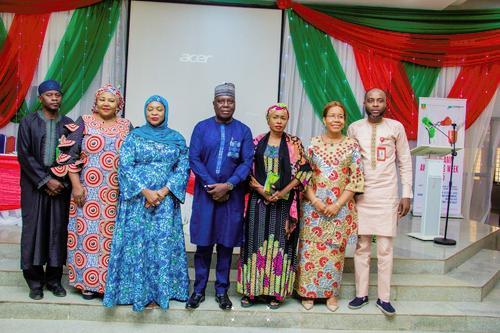
Speakers with host institution representatives.
Day two kicked off with a talk on infection control and hand hygiene led by myself. This was followed by a practical session on hand hygiene. Students joined a lively quiz, created AMR awareness slogans, and participated in glow-gel demonstrations and the ‘illness-spreading activity’. The event closed with an award session and an AMR champion pledge.
Did the event meet its initial aim?
Yes, the event met its initial aim. Feedback from students and other attendees confirmed that.
Some student feedback:
- “The workshop strengthened my understanding of AMR and has inspired me to take action as a future AMR ambassador”.
- Feedback highlighted the hands-on activities as very memorable.
- The students expressed a strong interest in pursuing careers in the life sciences.
- One student was surprised to learn that clean hands are not automatically hygienic.
Some feedback from chaperones:
- A Vice Principal of one of the schools commended the organisation of the workshop and promised that the students that participated would have the chance to share what they learned and their experiences with the whole school.
- “The students will remember what they learned in the workshop for several years to come because they listened, they watched, they saw and they were involved” (Vice Principal of one of the schools involved).
- An attendee admitted he never finished his antibiotic and antimalarial courses, but now he knows better.
Lessons I learned from organising the workshop
- Planning early made a huge difference – meeting the NDA authorities early secured one of the best halls and the Academy band provided music to the delight of the students. It also meant that souvenir plaques were provided for the guest speakers.
- Keeping the schedule loose worked well – questions kept flooding in from the students and other participants.
- Hands-on-activities were the most exciting part of the workshop and kept the atmosphere very lively and engaging.
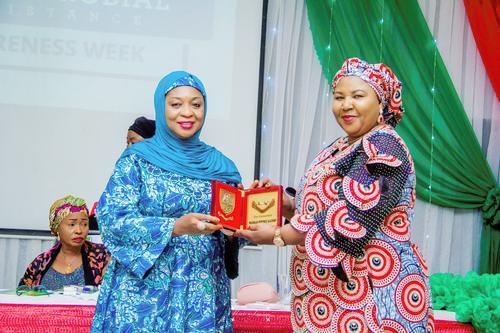
One of the speakers receiving a souvenir.
Seeing the students’ enthusiasm and excitement was captivating; it felt like they wished the workshop would never end. Their questions kept flowing, even after the session wrapped up. The impact may be quiet at first, but absolutely priceless!
A huge thank you goes to the Microbiology Society for funding the event; the Nigerian Defence Academy for hosting; and to speakers, facilitators and administrations of the invited schools, all of whom contributed to making the workshop a resounding success.
Find out more about the Champions Scheme and the activities our Champions undertake on our Society Champions page.