
Finding wonder in the invisible: How A Microscopic Odyssey brought microbiology to life at the Edinburgh Fringe

I am approaching my final year of my PhD, which aims to characterise the atypical Salmonella serovar, Salmonella Uganda at the University of Strathclyde in Glasgow, UK. My time undertaking my PhD has refined my research interests, which now centre around the One Health paradigm and food safety. These areas highlight the crucial and interconnected roles that microorganisms play in our health, food systems, animals and the environment. Alongside my research, I carry out outreach activities both within my institution and externally. These experiences have made me increasingly interested in how we can effectively communicate microbiology and engage people with the microbial world.
The Edinburgh Fringe is a three-week celebration of performing arts and is one of the largest celebrations of arts and culture worldwide. It aims to provide an inclusive platform for both established names and emerging artists. This environment may not be the first place that comes to mind when thinking about microbiology. However, it provided the perfect setting for A Microscopic Odyssey to take audiences on a journey into the invisible microbial world, through storytelling, movement and visual theatre.
Imaginative storytelling to showcase the microscopic world
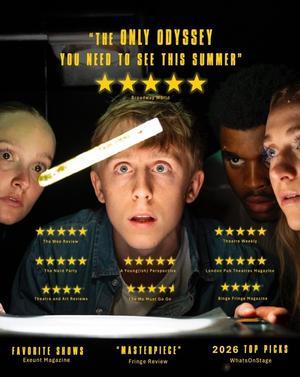
Created by the Mycelium Theatre Company, A Microscopic Odyssey is based on the true-life story of James Weiss, a microbiologist, storyteller and independent researcher. Following personal trauma, James turns to the hidden universe of microbes and discovers an entirely new world for himself, where he navigates survival, connection and wonder.
This cross-disciplinary production transforms James’s story using handcrafted imagery, analogue projection, his own microscopic footage and movement to provide an immersive visual experience. Blending science and handcrafted illusion, the show documents a story of survival and re-emergence at its core. The resulting, visually epic experience, invites audiences to look closer and rediscover wonder in the smallest corners of existence.
One of the highlights for me was how the production played with scale. Something microscopic can easily be perceived as insignificant, yet the performance transformed the microbial world into something vast, immersive and extraordinary.
A Microscopic Odyssey tackles the challenge of communicating the microscopic world through creativity rather than explanation. Instead of overwhelming the audience with scientific terminology, it uses visual storytelling to create a genuine sense of curiosity. At the heart of the production is a message about rediscovering the childlike sense of wonder that can so easily be lost as we grow older. Through James’s story, the production also offers a message of hope and encouragement, demonstrating how looking closely at the microbial world can provide a new perspective.
From humble beginnings to the Edinburgh Fringe
The journey of A Microscopic Odyssey began as a final degree show at the London Academy of Music & Dramatic Art (LAMDA) a year ago. It has now grown to an hour-length production which had an extremely successful run at the Edinburgh Fringe. This journey demonstrates the remarkable potential of combining science and theatre.
The inspiration for the production was developed when director, Hope Wishart, watched a short documentary, A Body Called Life, by Spencer MacDonald at the Cannes Indie Short Film Festival in 2024. The documentary followed the life of James Weiss; Hope was intrigued by James’s extraordinary way of seeing the world, as well as the connections he made between microorganisms, humans and the universe. Hope subsequently contacted James directly, pitching the idea of creating a theatre production based on his life. Following numerous interviews exploring James’s life story, this became the foundation for A Microscopic Odyssey.
The production has received strong reviews, including five stars from The Wee Review, which states: "In the year of The Odyssey, this is arguably the most epic manifestation of them all." Audience member Edward Shirley similarly described it as “One of the best pieces of theatre you can see in or indeed out of the fringe…”.
The production team hopes to continue its journey, by taking the show to international festivals and developing new productions with Mycelium Theatre Company.
The power of curiosity
One of my biggest takeaways from A Microscopic Odyssey was the importance of curiosity. Curiosity is often a major driver for scientific discovery; it encourages us to ask questions and to explore the unknown. However, as we progress through our careers, our innate curiosity can become overshadowed by experiments, deadlines, publications and the pressure to produce results. This production worked as a reminder to take a step back and appreciate the remarkable world of microorganisms which initially sparked that curiosity and drive.
Given my interest in One Health, I particularly connected with the production’s message about the interconnective nature of microorganisms and the world around us. It made me reflect on how easy it is, as researchers, to become so hyper-focused on our specific areas of study that we lose sight of the bigger picture.
It was also intriguing how these messages were portrayed, without relying on scientific terminology or lengthy explanations. Instead, the production focused on movement, light, projection and microscopic imagery to elicit an emotional response and ultimately create a connection between the audience, the science and James’s story.
Overall, this made me reflect on the challenges of scientific communication. As scientists, we rely on communicating what we know, but effective engagement must also encourage people to become curious about what they do not know. Creating that sense of wonder and curiosity could be the first step towards encouraging someone to look closer… perhaps under the microscope!
If you are interested in finding out more about A Microscopic Odyssey you can follow Mycelium Theatre Company on Instagram.