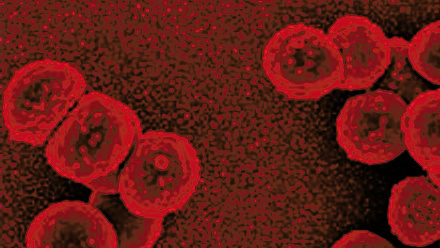
Girls in Biotech Fellowship 2026: empowering the next generation of women in biotechnology
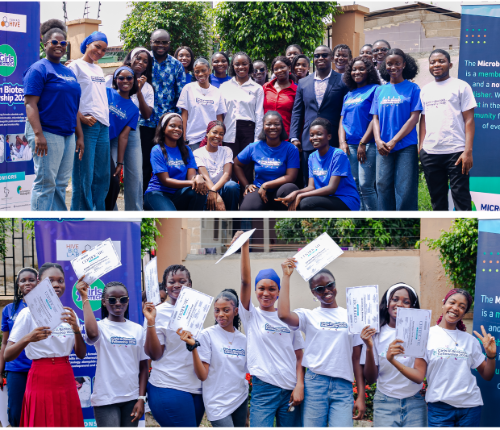
Girls in Biotech Fellowship 2026 closing ceremony
Modern biological research increasingly depends on the combination of laboratory techniques and computational tools to answer complex questions. Yet for many young scientists in Africa, access to hands-on laboratory training and bioinformatics education remains a challenge.
The Girls in Biotech Fellowship (GIB) 2026 was designed to help close that gap by giving young women the chance to build laboratory, research, computational and professional skills. The Fellowship was organised at Hive Biolab, Ghana, by Simeon Makafui Nutsuklo and Caroline Anani Edem, with support from the Microbiology Society (through the Champions Scheme), Inqaba Biotec West Africa and The Company of Biologists.
Hive Biolab is an open community biotechnology laboratory space that operates within Kumasi Hive in Ghana, established in 2019 as a shared space for practical learning, research and experimentation. Through open science, prototyping, practical training, applied research and community engagement, Hive Biolab supports students, young scientists and aspiring biotechnology innovators to develop practical skills and explore how biotechnology can address local challenges.
The Fellowship reached 165 women through two complementary modules. The first, was a three-month virtual bioinformatics programme for 140 women across multiple countries and diverse biological fields. The second, was an in-person wet-lab programme in microbiology and molecular biology for 25 young, female scientists in Ghana, delivered over four to five weeks.
Building practical skills in microbiology and molecular biology
The in-person, wet-lab, cohort brought together women from veterinary medicine, biochemistry, biological science and biotechnology departments at the University of Energy and Natural Resources, Ghana, and Kwame Nkrumah University of Science and Technology, Ghana. Training centred on antimicrobial resistance (AMR), a growing global public health concern, explored through both microbiological and molecular perspectives.
Fellows started with fundamental laboratory techniques/practices, proper documentation, aseptic techniques, micropipetting, sample collection and preparation, as well as serial dilution. They then advanced to culture media preparation, bacterial culturing and subculturing, staining, microscopy and biochemical tests, to isolate and characterise environmental isolates. They also completed an antimicrobial susceptibility test (AST) to identify the antimicrobial effectiveness against the isolated cells.
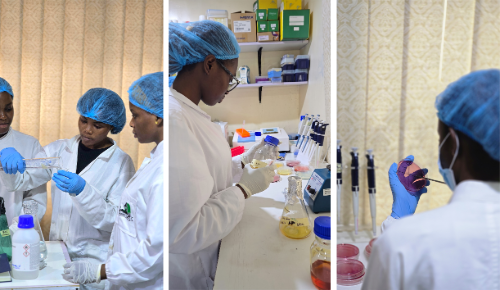
Fellows practicing 70% ethanol preparation, media preparation and streaking
During AST, many isolates showed resistance to tetracycline, which raised a follow-up question: will there be a genetic presence and confirmation of tetracycline resistant genes? That question became the bridge between microbiology and molecular biology for the fellowship.
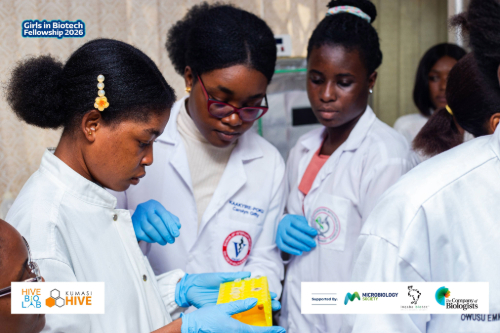
A group of fellows arranging their tubes on a rack for DNA extraction
During the molecular component, the fellows designed tet(B) and tet(M) primers, which were synthesised by Inqaba Biotec West Africa. They then started with DNA extraction, moved to PCR and agarose gel electrophoresis, completing their gel annotation and interpretation, where they confirmed the presence of these genes in some samples.
Before working with bacterial isolates, they practised DNA extraction on tomato and cassava leaves, using the Edwards and Delaporte protocols; checked the quality of the extracted DNA by gel electrophoresis and ran PCR, targeting the plant actin gene. The exercise gave them hands-on experience in DNA extraction, DNA quality check and PCR.
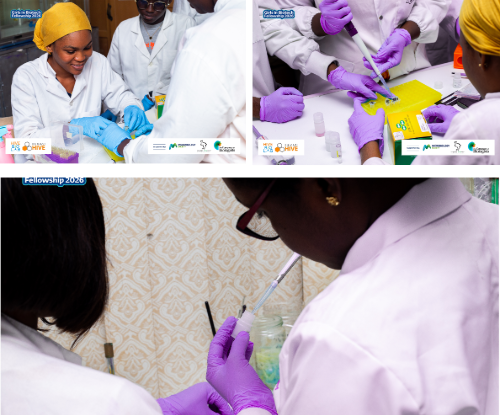
Fellows loading their samples into tubes during the molecular biology module
With that confidence, they used Zymo Quick-DNA Miniprep Plus kits, donated by Inqaba Biotec West Africa, to extract DNA from the bacterial isolates. The kits introduced a streamlined extraction workflow that made DNA extraction quick, more convenient and helped fellows move on to downstream molecular analysis.
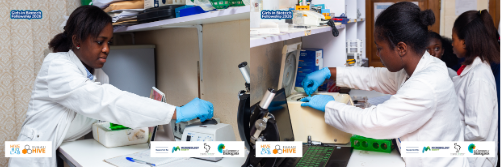
Fellows performing vortexing and spinning/centrifugation of samples
Finally, the fellows ran PCR targeting tet(M) and tet(B) to test whether these two tetracycline resistance genes were present in the isolates. The exercise showed how different methods complement each other in AMR research: AST reveals an isolate’s observed resistance phenotype, while PCR looks for specific genetic markers.
By moving from bacterial culture and susceptibility testing to DNA extraction and PCR, fellows saw how separate techniques build into a single scientific investigation. Along the way they sharpened their ability to follow protocols, handle samples, interpret results and ask questions that guide further research.
Taking bioinformatics training to a global audience
While the wet-lab programme focused on bench work in Ghana, the virtual bioinformatics programme extended the Fellowship’s reach to an additional 140 women across multiple countries. This cohort was delivered over three months, which introduced participants to R programming, statistical analysis, genomic and sequence data analytics and interpretation, as well as microbiome dataset workflow.
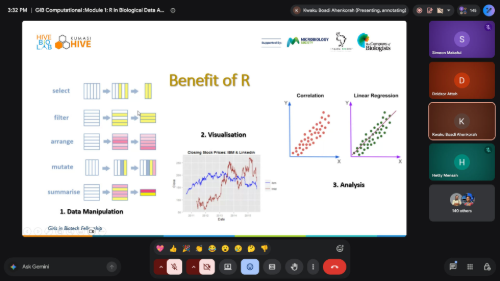
Introduction to R – Module 1 of the bioinformatics cohort
This cohort had three modules. Module 1 covered R fundamentals, including descriptive and inferential statistics. Module 2 focused on genetic data exploration and population analysis, covering data filtering, marker summary statistics, population statistics, Analysis of Molecular Variance (AMOVA), Principal Coordinates Analysis (PCoA), clustering and the silhouette method, Discriminant Analysis of Principal Components (DAPC), as well as phylogenetic tree visualisation and analysis.
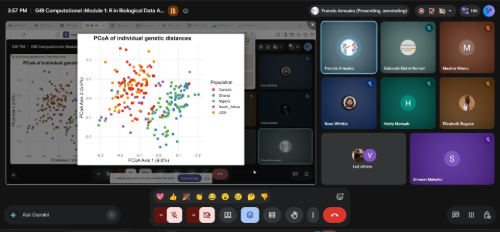
Module 2 of the bioinformatics cohort
Module 3 focused on sequence data analysis, introducing fellows to computational approaches for working with biological sequence data.
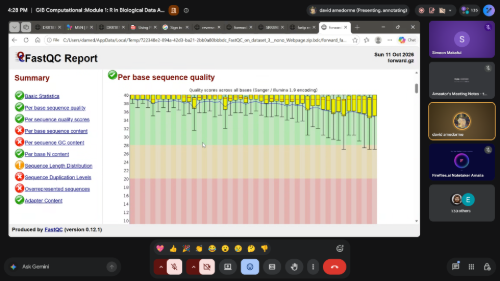
Module 3 of the bioinformatics cohort
Throughout the programme, assignments after each module gave participants the chance to practise the methods and concepts from live sessions. Sessions were recorded and fellows who were unable to join the live sessions had the chance to go through them before attempting the assignments. The bioinformatics programme concludes in October 2026 with a major capstone project, where fellows will apply the knowledge and skills they have gained across the three modules.
Learning through practice, mentorship and application
Practice has been the defining feature of the GIB Fellowship 2026. In the wet-lab programme, participants applied laboratory techniques to real questions revolving around antimicrobial resistance. In the virtual cohort, fellows progressed from statistical fundamentals to specialised methods for analysing genetic and sequence data. Assignments after each bioinformatics module encouraged practice beyond the live sessions and the capstone project will consolidate that learning through application.
The Fellowship also recognises that scientific development involves more than technical knowledge. Professional development activities introduced participants to Google workspace, research and presentation skills.
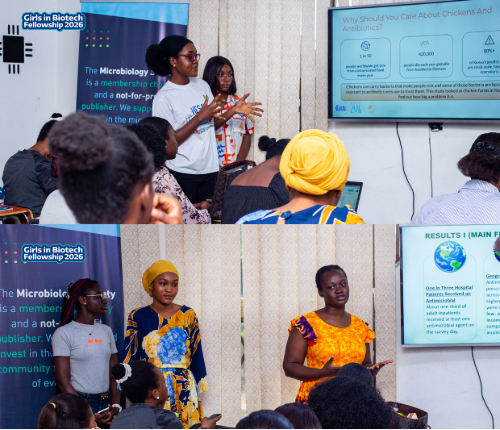
Presentation by fellows on AMR
The wet-lab cohort’s closing ceremony, held at Kumasi Hive on 6 October 2026, celebrated the fellows’ progress and gave them space to reflect on their experience. The programme featured presentations and a speed mentorship session with professionals working across biotechnology, research, academia and entrepreneurship, who shared perspectives on research, postgraduate studies, careers in science, leadership and professional growth.
These conversations connected the technical training to possible academic and career pathways, and gave fellows a chance to engage directly with professionals and learn from their experiences.
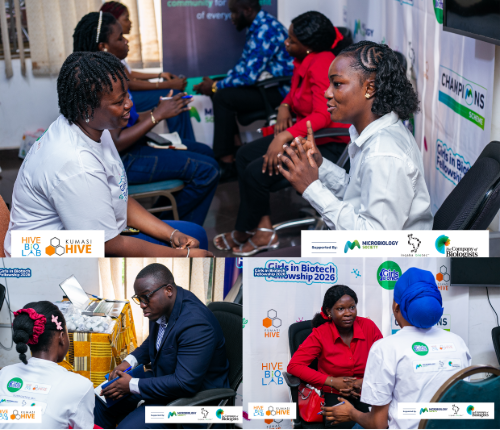
Speed mentorship session
The Hive Biolab team at Kumasi Hive is grateful to the Microbiology Society for supporting the Fellowship through the Champions Scheme, to Inqaba Biotec West Africa for sponsoring the molecular biology module and to the Company of Biologists for sponsoring the bioinformatics module.
For all updates on the Fellowship, please visit the Hive Biolab LinkedIn.
You can find out more about the activities our Champions are organising on our Champions events and activities page.