
Global Accessibility Awareness Day: Abbie Storan
Could you tell us about yourself?
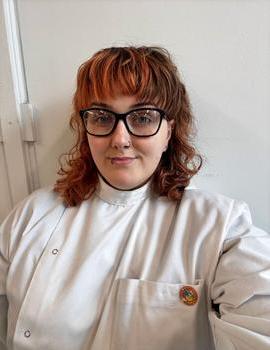
My name is Abbie, I’m a third-year PhD student at the University of Huddersfield, UK, and, this year, I also became the Early Career Forum representative for the Society's Eukaryotic Division. My PhD research utilises molecular, synthetic and structural biology techniques to characterise and engineer components of the yanuthone biosynthetic pathway, more specifically yanuthone D, with the long-term goal of producing novel yanuthone-based antimicrobials. Previous research indicates that yanuthone D has antimicrobial activity against MRSA and vancomycin-resistant enterococci. At the moment, I’m working on purifying P450 proteins produced by two genes involved in the biosynthetic pathway of yanuthone D.
I’ve also been given the great opportunity to contribute to another project, utilising my microbiology background, running antimicrobial susceptibility testing of self-assembling trimetallic cryptands against MRSA, to investigate their antimicrobial potential, following previous research which found them to be highly toxic to cancer cells in human cell lines.
It’s Global Accessibility Awareness Day on 21 May 2026; will you be doing anything to raise awareness?
Well, thanks to the Microbiology Society, I’ve been given the chance to do this Q&A, which I hope will raise awareness of some underrepresented conditions and encourage people to think more about improving accessibility in the sciences.
I understand you have been diagnosed with autism, Attention Deficit Disorder (ADD), dyspraxia and dyscalculia. Could you tell us how your disabilities and conditions have impacted you and your career journey?
Yes, I was diagnosed with autism when I was 16 – it was a big surprise to me and my whole family initially, but the more we learned about it, the more things clicked into place. Getting that diagnosis was extremely helpful for getting my school and college to accommodate me with things like doing my exams in a smaller, quieter room (with breaks and extended time allowances), and accessing SEN rooms to do my work in when I couldn’t handle being in class or needed a quiet place to spend breaks.
Strangely, I’d say the first impact this had on my career journey was a pretty positive one, which started with me dropping out of university after a couple of months in 2017. I’d gone to study English Literature, but my mental health conditions and autism were affecting me so badly that I dropped out. At the time, the following two years were a difficult period, but it led me to think about what I wanted to do next, which turned out to be studying Human Biology and Infectious Diseases at the University of Salford, UK, in 2019.
Again, I benefitted from extra time in exams, and extended deadlines for coursework and library loans but, for the first time, I was also paired with a study mentor from a company called Randstad, which provides assistance to Disabled students. This was really helpful for me, having someone to offload to who could help me manage my workload, as well as the emotional load of being at university.
Fast forward a few more years, and I was diagnosed with dyscalculia, dyspraxia and ADD in 2024, during the second year of my PhD. I initially sought out the dyscalculia assessment because I’ve always struggled massively with maths and identifying or remembering symbols. I was always in the bottom sets for maths at school, I failed my maths GCSE and had to retake it another three times in college, and I was struggling in my PhD too.
I’d never heard of dyscalculia until around 2020, and I’d wondered since then whether I had it, but wasn’t sure how to get assessed. So, when I attended a wellbeing session at university, after panicking about struggling with the level of maths involved in my PhD, and the adviser told me I could be assessed on campus and would only have to contribute £100 towards it, I agreed immediately.
The assessment covered all specific learning difficulties (SpLD) and included a screening for ADHD, so I ended up receiving diagnoses for dyscalculia and dyspraxia, alongside a positive ADHD screening, which I followed up with my GP to receive my ADD diagnosis.
Getting these diagnoses was really important to me because they finally helped me fit pieces of my life and personality together that I’d struggled to understand before. I’ve also been able to spend more time reading and learning about my conditions, including how they interlink and how to make adjustments in my life to minimise the negative effects.
My conditions have impacted my career journey mostly in a mental way – I have really low confidence in myself and awful imposter syndrome from years of second-guessing everything I do or think and feeling stupid and anxious. This has made me completely avoid presenting my work at conferences or seminars, even though I know it is an invaluable experience for PhD students and researchers to share their work and exchange knowledge.
Another impact, is the amount of time my brain and body need to process information, whilst simultaneously trying to process all the other stimuli in day-to-day life, since it’s well documented that Neurodivergent people process things very differently, and often more slowly than neurotypical people.
I regularly feel like I don’t get as much done day to day in my work (or done quickly enough) because of how long it can take me to plan, organise and execute tasks. I’ve also had to learn ways to accommodate my conditions so that I can avoid or minimise a meltdown or burnout. This has included taking a few short breaks from my PhD over the last three years; having regular sessions with my study mentor from Randstad; carrying headphones with me (to listen to podcasts, or watch TV on my phone, during breaks to help distract me from feeling overwhelmed) and keeping in touch with the disability and wellbeing services at my university when I need more support.
I have not heard much about dyscalculia, are there any particular challenges in having dyscalculia, especially when studying microbiology, that others may not be aware of?
Dyscalculia affects around 6% of the population and isn’t simply ‘dyslexia for maths’, as I’ve seen it described before. It is also characterised by difficulties with timekeeping and understanding concepts of time and money.
It makes counting, remembering strings of numbers, understanding formulae and carrying out equations really difficult, which are all extremely common aspects of studying and working in microbiology. So, it takes more time for me to work out answers to equations, or understand formulae. I rely heavily on calculators and online conversion or dilution tables in my work too, because I just can’t do those calculations in my head.
Difficulty judging time is also challenging in microbiology, especially when planning long experiments or assays, or managing several in one day. I often end up working right up until closing time in my lab because I’ve misjudged how long something will take to complete.
What are some of the access requirements people living with dyspraxia and dyscalculia might need that others may not have considered?
The main one is assistive technology. This can include things like speech-to-text software, screen readers, organisational software or apps and modified keyboards or mice. Flexible working patterns that do not follow the typical 09:00–17:00 Monday–Friday structure can also be really important; alongside specialised support services, alternative assessment methods in education or the workplace and extra time allowances.
I also believe workplaces and universities need to provide more training for managers and tutors, so they are more aware of these conditions and how to accommodate them.
Is there any advice that you would give to other Neurodivergent or Disabled people who are studying (or hoping to study) science?
My main piece of advice would be not to isolate yourself. Whether you join a society for Disabled or Neurodivergent students, register with disability services, or access study or support mentors, it’s important to have people you can lean on when you’re struggling.
My other piece of advice is that being interested in science is enough. Regardless of disability or neurodivergence, if you have an interest in science, you can pursue it. I’d probably benefit from taking my own advice, really.
Do you think more needs to be done to support Neurodivergent and Disabled people studying or working in science?
Absolutely. Although people are speaking more openly about disabilities and conditions than they were 10 years ago, I still think there is a huge lack of support and accommodations in place to make studying and working in science viable for Disabled and Neurodivergent people.
When and why did you first become interested in microbiology?
I first became interested in microbiology during my undergraduate degree at the University of Salford, UK. My course provided modules across almost the full breadth of biological sciences, and I was always most interested in the microbiology modules. The tutors teaching those modules were really passionate about microbiology, so they left a big impression on me.
My undergraduate degree was also impacted by COVID-19. I only had around a year and a half of a ‘normal’ university experience before the lockdowns began, so my degree was hugely affected by it. However, the faculty used the situation to teach us more about topics like public health, epidemiology and microbiology in real life, rather than purely through textbooks and journal articles.
After graduating, I followed this interest by studying for a master’s in medical microbiology at the University of Manchester, UK, where I got to work with even more tutors who were passionate about microbiology and taught me a lot about applying what I’d learned throughout my degrees to the real world.
If you hadn’t decided to study molecular biology or microbiology, what career path do you think you would you have chosen?
Well, my family have told me many times throughout my life that they pictured me working in the death industry. My mum has said a few times that she imagined me working in morgues or funeral homes. I take it as a compliment really, because those types of jobs require someone who isn’t fazed by gross or morbid things and who can provide a really essential service.
You attended the Disabled and Neurodivergent Members Social at Annual Conference 2026, why do you think it’s important for the Society to provide opportunities for members to organise and attend events like this?
I did! And it was honestly the highlight of Conference for me – I had so much fun meeting everybody.
I think it’s important for the Society to provide opportunities to organise and attend events like this because, although conferences are really interesting and a great experience, they are also very busy places with lots of people, which can make it difficult to properly meet others and build connections.
Having organised events and activities like this is, therefore, a really useful way to meet people who share similar interests and experiences.
You also recently joined the Eukaryotic Division as the Early Career Forum representative. What made you want to get involved in the Society’s governance and organising conference sessions?
I attended my first Annual Conference in 2025 in Liverpool and visited the Get Involved stand, where I got to chat with a number of people involved in the Society’s governance. It was really interesting to learn how directly involved those people were in organising conference activities and sessions, as well as influencing the kinds of projects the Society produces.
It really appealed to me because I’m always looking for ways to broaden my experience, build my confidence and develop professionally. So, as soon as I got back from Conference last year, I started reading through the role descriptions. Being part of the Eukaryotic Division, representing the Early Career Forum, felt like a great opportunity to become more involved with the Society and give something back to it, since it has given me the opportunity to attend conferences and events.
Find out more about the Society’s equality, diversity and inclusion initiatives, including similar awareness day blogs from members.