
Launching the Microbiome Innovation Network
High-throughput sequencing has made us very good at asking who is there. We can now identify the bacteria, archaea, fungi, viruses and microbial eukaryotes in a microbiome with great accuracy. We’re also getting much better at seeing what they are doing. So the next questions are bigger ones. Can we use, predict, engineer or manipulate microbiomes? And if we can, how do we turn that into useful products and processes for people and the planet?
Different microbiomes, shared challenges
The UK is a world leader in microbiome research, and microbiomes are rightly getting more attention from Parliament, regulators and funders. The UK market for human microbiome products alone was worth $72.0 million in 2025. It’s expected to reach $334.4 million by 2030, with annual growth of 29.2%. Products are already on sale in food and nutrition, personal care, animal health, agriculture and industrial biotechnology. Live biotherapeutics, defined microbial consortia and phage-based approaches are coming next.
Expertise isn’t what’s holding us back. Connecting it is. A gut probiotic, a crop biostimulant and a bioremediation process may look like they have nothing in common. But they run into many of the same barriers: regulation, standards and methods, data integration, access to samples and manufacturing at scale.
The need for a network of networks
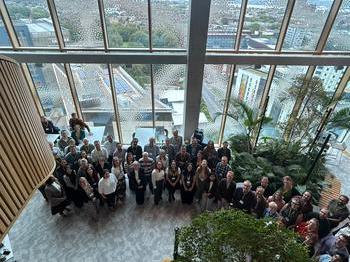
To tackle these shared challenges, we launched the BBSRC-funded Microbiome Innovation Network (Microbiome-Net), led by the University of Liverpool, the National Biofilms Innovation Centre (NBIC), Nottingham Trent University, the Quadram Institute and the University of Oxford, on 21 September 2026 at The Spine in Liverpool. Sixty-two academics, industry representatives, government agency staff and other stakeholders came in person, and twelve more joined online. More than 280 members had already signed up to the network before the launch.
The network builds on the work of the Innovate UK Business Connect Microbiome Innovation Network. Since 2019, it has grown into a cross-sector community and has helped set up regional networks in Liverpool, Glasgow, the East Midlands and Oxford, producing the Microbiome Strategic Roadmap, which Microbiome-Net now aims to deliver.
Our approach is built around communities working on human, animal, plant and environmental microbiomes. Members can learn, connect, collaborate, access, innovate and shape the field, with the chance to lead activities as well as take part.
From lab to market
One of the roadmap’s key priorities is helping researchers turn discoveries into products. On the day of the event, we also launched the Entrepreneurship and Innovation (E&I) Hub, which trains, connects and signposts microbiome researchers who want to commercialise their work. The hub offers:
-
Conversations with “experts in residence” from our new Industry Advisory Group, which includes start-ups, large corporations and former senior industry leaders.
-
Drop-in sessions with the hub team.
-
Self-serve webinars on IP, market exploration, regulation, manufacturing, investment and pitching.
We also heard from the MAID (Microbiome: Accelerating Innovation and Development) Hub. Run by the University of Liverpool’s Microbiome Innovation Centre and CPI, it helps organisations move microbiome technologies from proof of principle to scale-up and manufacture.
Existing working groups, networks and activities
Short talks showed the range of activity already happening across the community:
-
Biobanking Working Group: The group set out a vision for a connected UK Microbiome Biobank, with a central hub and thematic spokes. A workshop was held the day after the launch and a report will be published shortly.
-
Microbiome safety: We heard about building scientific consensus on which host–microbiome functions need protecting through workshops hosted by the Microbiology Society.
-
Phage regulatory sandbox: The multi-agency regulatory sandbox aims to bring regulatory clarity to engineered phage products across One Health.
-
UK Plant Microbiome Network: The network has grown to more than 270 members since May 2025. It summed up its recent conference with the line that the field does “not have a discovery problem, we have a delivery problem.”
The morning ended with a keynote from Dr Micky Whittle of the Waltham Petcare Science Institute. Micky talked about their research on the canine gut and skin microbiomes, which has uncovered many previously unknown species. The talk also looked at how this work could support pet health and the benefits of early interventions in dogs.
Microbiome funding and seed money
We heard a summary of the current funding landscape from Innovate UK Business Connect and international partners. We also announced the Microbiome-Net Seed Fund, which will offer small awards of up to £2,500 and up to £10,000. They’re meant to spark new collaborations across academia, industry and other sectors.
Round tables: what’s holding us back?
In the afternoon, delegates split into seven round tables:
-
careers for early-career researchers
-
equality, diversity and inclusion in microbiome innovation
-
how policymakers and funders can help
-
supporting the next generation of researchers and entrepreneurs
-
UK opportunities and hot topics
-
what infrastructure we should build together
-
what is holding innovation back
The conversations were lively, and several themes emerged across the tables. Regulatory clarity topped the wish list. Health products have relatively clear pathways, but agritech and engineered microbiome products do not, and delegates called for earlier, more open dialogue between innovators and regulators. IP and technology transfer were seen as major bottlenecks for academics. Many tables stressed the need to “think of the end product” from day one. Delegates also highlighted that fundamental, mechanistic research and good model systems are essential to reducing the risk of translation, yet often struggle for funding. Data sharing, diverse study populations and embedding EDI in the network’s governance all featured strongly. There were clear asks of Microbiome-Net too: fast, lightweight seed funding; flexible internships; an early-career researcher forum; and an EDI advisory group.
What’s next?
At the heart of the network’s next phase are our working groups: open, community-led groups where academics, industry, regulators and other partners tackle shared challenges together. They are:
-
Biobanking, Standards & Data
-
Entrepreneurship, Commercialisation & Manufacturing
-
Equity, Diversity & Global Relevance
-
One Health
-
Phage Innovation
-
Research Design, Discovery & Translation
Each group will agree two or three focused goals for its first year. They will spend the first months mapping UK capability and gaps, then move on to practical outputs, such as a directory of biobanks and facilities, commercialisation guidance, validation and translation guidance, recommendations for more inclusive research, and a phage capability map. The groups also connect directly to what we heard at the round tables, from clearer regulatory pathways to fairer representation in microbiome research. Membership is open to all, and we especially welcome colleagues from industry and the public sector.
To get involved, sign up on the Microbiome-Net website.
The Microbiome-Net Training Blocks will start in early 2027, with the first block on entrepreneurship and innovation. Later blocks are planned to cover: study design, functional microbiomics, engineering and intervention strategies, data and AI, regulation and ethics.
Microbiome-Net is also taking over organisation of the highly successful Microbiome Innovation One Health Conference, previously held in Glasgow, Liverpool and Oxford. MIOHC 2027 will take place at Nottingham Trent University on 23–24 March 2027.
Different microbiomes, different applications, shared challenges: one innovation community. We’d love you to be part of it.
Get involved: follow us on LinkedIn, visit our website, or email [email protected].