
One Health, One Future: the tiny microbes that could shape our future
Imagine a future where a simple cut, a routine surgery or a common infection becomes life-threatening because antibiotics no longer work.
Now imagine that some of the smallest organisms living inside your body, too tiny to be seen, could play a decisive role in protecting your health. It may sound like science fiction, but it is rapidly becoming a scientific reality.
Two of the biggest public health challenges of our time, antimicrobial resistance (AMR) and the declining health of the gut microbiome, are more closely connected than most people realise. While scientists around the world race to develop new medicines, one of the most powerful solutions already exists: awareness.
With this vision, the Microcosm Association at SGT University, India, and the Department of Nutrition and Dietetics, India, organised a scientific awareness programme: One Health, One Future: Focusing on antimicrobial resistance and the gut microbiome. The programme was held at the Government Senior Secondary School in Budhera Village and supported by the Microbiology Society.
The programme aimed to introduce secondary school students to the importance of responsible antibiotic use and the role of the gut microbiome in maintaining health. To make the session engaging, we began with a short story, illustrating how the misuse of antibiotics today could affect future generations. This was followed by a video on AMR, which helped students understand this global health challenge through real-life examples.
Rather than a traditional lecture, the programme encouraged active participation through interactive discussions as well as question and answer sessions. Students enthusiastically asked questions such as "Why don't antibiotics work against the common cold?" and "Can bacteria actually be good for us?". Their curiosity created an open and lively learning environment.
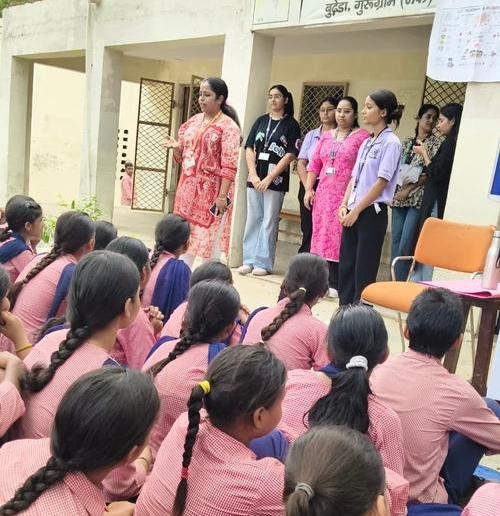
To reinforce the key messages, we organised a quiz competition on AMR and the gut microbiome, along with a poster-making competition where students creatively illustrated themes such as responsible antibiotic use, hand hygiene and healthy lifestyles. The enthusiasm and creativity displayed by the students was inspiring. Prizes were awarded to the winners of both competitions to recognise their efforts and encourage scientific learning.
A live handwashing demonstration formed another important part of the programme. Students learnt the correct handwashing technique and understood how this simple practice helps prevent infections, reduces the unnecessary use of antibiotics and contributes to combating antimicrobial resistance. Through these activities, students discovered that beneficial microorganisms, living in the gut, play an essential role in digestion, immunity and overall well-being. They also learnt that balanced diets, fibre-rich foods, adequate sleep and the responsible use of antibiotics help maintain a healthy gut microbiome. Most importantly, they understood that protecting beneficial microbes and preserving the effectiveness of antibiotics are closely connected.
One of the most rewarding aspects of the event was witnessing the students' enthusiasm and willingness to learn. Their active participation demonstrated that complex microbiological concepts can be communicated effectively when linked to everyday life. We hope these students will carry these messages beyond the classroom and become ambassadors for responsible antibiotic use and healthier lifestyle choices within their communities.
The theme ‘One Health, One Future’ reminds us that the health of people, animals, microorganisms and the environment is inseparably linked. As the world confronts the growing challenge of AMR, our greatest defence may not begin in a laboratory or a hospital, but in classrooms. Because the most powerful medicine we can pass on to the next generation is not found in a bottle; it is knowledge.
Find out more about the activities our Champions are organising on our Champions events and activities page.