
Professor Jeff Cole: a tribute
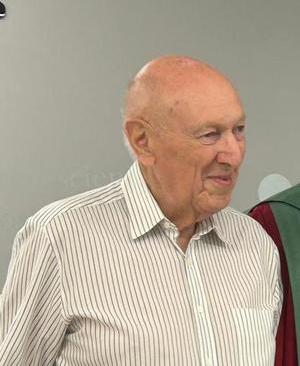
As his friend and long-time collaborator Ian Henderson (a former trustee of the Society) put it, “It is with profound sadness, softened only by the immense gratitude for having known him, that we celebrate the life of our dear friend, mentor, and scientific sparkplug, Professor Jeff Cole. Jeff was a man whose curiosity, kindness, and mischief lit up every room, every classroom, every lab meeting, and every dinner table he ever touched.”
Current Society President Professor Gordon Dougan led the tributes, saying: “The Society recently lost one of its most loyal and valued members, Jeff Cole. Over a 50-year period he contributed in so many ways to the Society and science generally. He was part of a group, including the legendary Harry Smith, that built Birmingham University into a world-leading centre for microbiology. He also trained dozens of high-quality researchers and clinicians. I knew him as an outstanding microbial geneticist working on important aspects of metabolism in E. coli and other bacteria. His work on the regulation of anaerobic and nitrogen metabolism, including his long-standing collaborations with Steve Busby, transformed our understanding of gene regulation in bacteria. On a personal note, it was his observations on the nitrite regulon that stimulated my team to use the nirB promoter to drive the expression of vaccine antigens in bacterial vectors. These promoters could be turned off during fermenter runs but self-activated when the vectors entered the human body, greatly simplifying manufacturing.
Jeff was a modest person who I would describe as a ‘gentleman scientist’. Always constructive, he was able to stimulate others and create a wonderful working environment. He served the Society in many ways. I particular want to call out his selfless work as an editor and mentor to those involved in publishing our journals. It is important to note that this was unpaid voluntary work he undertook to support and serve our community. His recent support for our editorial teams, particularly on Access Microbiology, has helped us move towards pioneering approaches to open access publishing. He will be missed but not forgotten.”
The current Editor-in-Chief of Access Microbiology Helina Marshall recalls: “Jeff Cole was a generous mentor, rigorous scientist, and deeply committed member of the microbiology community. I first met Jeff as an undergraduate at my very first conference in 2012, where his thoughtful, kind, and supportive nature immediately stood out. Those qualities remained constant throughout our professional relationship and were emblematic of how he engaged with colleagues at all stages of their careers. When Access Microbiology was launched with the aim of pairing junior editors with more experienced members of the community, Jeff was an obvious choice for the role of Editor Mentor and I was fortunate to be paired with him. The support he offered was instrumental in giving me the confidence to move forward as Editor-in-Chief. Through both good times and difficult moments, Jeff was always available with encouragement, insight, and, when needed, honest opinions delivered with integrity and care. Through his leadership, mentoring, and unwavering support of colleagues across disciplines, Jeff left a lasting mark on European science. He will be remembered not only for what he achieved, but for how generously he helped others achieve it.”
Former Treasurer Colin Harwood recalls that he first met the ‘Force of Nature’ that was Jeff Cole 55 years ago, at a Northern Bacterial Genetics Group meeting. “Jeff established this group while a young lecturer at Birmingham, together with my PhD supervisor, Simon Baumberg. Jeff was a fantastic colleague, but the more so a good friend with whom I spent many enjoyable hours. Others will speak about the importance of Jeff’s scientific achievements in the fields of bacterial nitrogen metabolism and anaerobiosis, but I knew him best as scientific community leader and editor. Jeff and I were both officers and subsequently honorary members of the Microbiology Society, but I got to know him well as he continuously found jobs for me within the European Federation of Biotechnology (EFB). He held many key roles within EFB, including Treasurer, Vice President and President. It is no exaggeration to say that, without Jeff’s total commitment to this organisation, EFB would probably not exist today. As he would be the first to acknowledge, Jeff’s commitment to science and the scientific community would not have been possible with the often-unseen background work and support of his wife Sudesh, to whom I send my sincere best wishes.”
Nigel Brown, who served as President of the Microbiology Society from 2012 to 2015 remembers: “I first met Jeff Cole when I was appointed to Birmingham University in 1988. However, I knew him by reputation earlier, both through his research and his work at the Society for General Microbiology (as the Microbiology Society was originally called). In fact, one of Jeff’s favourite memories is due to the Society. He had a discussion with Professor John Guest (Sheffield) in a Chinese restaurant in Brighton during a very cold January conference. This allowed them to compare their separate research programs, leading them to clarify how bacteria switch from aerobic to anaerobic growth through the actions of the regulatory protein FNR. Although we were originally in separate departments at Birmingham, we used occasionally to discuss our research projects, which were very different. Jeff could be challenging and bluntly ask very difficult questions, which suited me as it helped the science. Fortunately, he was content to be challenged in return. His benefit to science was not only through such open discussions, but also through his mentoring other researchers. Several distinguished scientists consider Jeff’s support in their careers – whether as PhD students, early-career researchers, or newly-appointed lecturers – as being important in their subsequent development. This was not limited to microbiologists, but also more broadly to biochemists, biotechnologists and others. When our two departments merged into the School of Biosciences in 1999, Jeff maintained a leading role in teaching and continued to support more junior researchers. There is no doubt that Jeff Cole has had a huge impact on European microbiology and biotechnology, both through development of organisations and support of individual scientists. He was certainly one of a kind!”
When asked about his memories of Jeff, Ian Henderson spoke about science, friendship, food, brilliant advice, how to write and how to laugh: “My own first encounter with Jeff was in the spring of 2001, during my interview visit to the University of Birmingham. I was barely in his office before he produced two tins of Boddingtons beer, cracked them open, and invited me to sit and talk science. Thirty minutes later, I was both clearer on my research direction and slightly tipsy. That evening, he and Professor Steve Busby whisked me off to Yasser Tandoori in Stirchley for my first Brummie curry. It was the beginning of a remarkable friendship and a mentorship that shaped my career and my life.
When my wife and I moved to Birmingham, Jeff and his wonderful wife, Sudesh, took us under their wings with the warmth of family. They welcomed us into their home for dinners with university colleagues, introduced us to hidden country pubs, and fed us unforgettable meals; Sudesh’s curries being the stuff of legend. They became woven into the fabric of our lives: Christmases, Thanksgivings, birthdays, fancy-dress parties, and every celebration in between. And for my children, Jeff and Sudesh were beloved surrogate grandparents. I will never forget the tie from the 1970s he gifted one of my daughters when she was six; she wore it everywhere, to his immense delight and our frustration – it didn’t really marry well with her first communion dress. When we moved to Australia in 2019, Jeff and Sudesh were the first to visit and we spent a wonderful time enjoying the fruits of Australia while Jeff and Sudesh engaged in one of their favourite pastimes – birdwatching.
Jeff always had a twinkle in his eye that signalled he was either about to teach you something, make you laugh, or, quite often, both. He questioned not to interrogate but to illuminate, to help students see deeper, think harder, and notice the connections they had missed. Jack Bryant, who was a postdoc with me and now at Nottingham, remembers vividly the theatrical flair Jeff brought to his undergraduate lectures: “He’d put one foot up on the highest table, shove his hands in his armpits, jangle a pocket full of change, and shout ‘There’s a pound in it for the right answer!’ Before you knew it, he’d be chucking a pound coin across the room and half the class would duck to avoid it”. Those antics weren’t just fun, they lit a spark and Jack went on to do his undergraduate research project with Jeff. Jack credits Jeff for setting him on the path to research and recalls Jeff’s booming voice at graduation, declaring across the under croft: “Jack, there’s been a mutiny - Steve has stolen you from me!” as Jack went on to pursue his PhD with Professor Steve Busby in their shared lab.
When he closed his lab, I was honoured that Jeff joined mine. We continued what was almost a tradition; in much the same way Jeff had adopted Professor Harry Smith into his lab when Harry retired, I adopted Jeff, and when I left for Australia Dr Amanda Rossiter subsequently adopted him into her lab. He became my students' quiet guardian, sharpening their experiments, their arguments, and most famously their writing. He could reduce a paragraph by half and double its impact. Nothing was allowed out the door until it had been thoroughly read, and rewritten numerous times in conjunction with Jeff. When students, Drs Emily Goodall and Jess Rooke even coined the verb and adjective “Jeffed,” to describe the process and end product of their writing, a term I still hope will one day enter the Oxford English Dictionary. In chatting with my students about their reflections of Jeff, Chris Icke recalls the legendary writing sessions that time has softened into gratitude: “We spent what felt like three hours on the first paragraph of my thesis, an uninteresting result about a growth curve showing no difference between a mutant and a wild-type, and didn’t get any further! At the time it was excruciating, but looking back I realise how much of his time and energy he poured into making my work the best it could be.” Whether it was a thesis, a presentation, or a scientific quandary, Jeff always showed up, prepared, practical, and intent on helping you shine. “It needed a lot of his time, but he gave it gladly.”
Today, my lab still abides by Jeff’s commandments in writing. For the historical record it is perhaps useful to record his “Golden rules” here.
Make sure the sub-heading is informative without stating the result. State what you were trying to do (your hypothesis). State what you did. State what you measured. State the result. State the conclusion. All third person, past tense. If you follow these guidelines, you are now ready to move logically to the next section. After 48 hours, re-read what you have written and check that you have followed these guidelines. Edit out junk words like “performed”, “carried out”, or junk phrases like “samples were taken and read” “It is interesting to note that….”. Would you ever write “It is extremely boring to mention that….? Of course not!
I hate to think how often I have failed Jeff’s commandments in recent papers!
Jeff was a scientist’s scientist: rigorous but imaginative, grounded but playful, brilliant but endlessly generous. He could make you rethink everything with a single gentle question. He could make a room erupt in laughter with nothing more than a raised eyebrow. In later years, he appeared to sleep through every lecture but then awake at the end to ask the most insightful questions. His knowledge of metabolism was unrivalled. Faye Morris, a student in my lab and now at Monash University, remembers Jeff as an encyclopaedia in human form: “The walking, talking EcoCyc” she called him, in awe of how he could glance at a list of genes and instantly know their functions and relationships. I recall one of those conversations with Jeff, where he declared “Of course everyone knows purine biosynthesis is connected to ….”: I am unsure to today if Jeff knew that not everyone knows! His enthusiasm, patience, and kindness, especially while helping her craft her fellowship application, left a mark she says she’ll never forget.
But above all, Jeff was a friend, steadfast, loyal, and joyful. Someone who made our lives richer, our science better, and our world brighter. Associate Professor Denise Leyton captured it perfectly when she shared, “Jeff was kind, which was a lovely reminder that world‑renowned scientists working in high‑pressure academic environments can still be warm, inclusive, and generous.” We all grew fond of his gentle mischief, and in time, we learned to return it in kind. As Dr Georgia Isom fondly recalled, “Jeff received the longest acknowledgement in my PhD thesis, written entirely in the font “Georgia”, which he had greatly disapproved of.” He laughed with us, guided us, and encouraged us, even from afar. Every success we had, he met with genuine delight and pride. Just days before he left us, the reviews for our latest joint paper arrived. He never had the chance to see them, but I think he would be quietly pleased to know we got another one across the line, together, as always.
We mourn him with heavy hearts, but we celebrate him with full ones. His legacy lives on in our work, in our stories, and in every student who still follows his five golden rules of scientific writing. We will miss him deeply. We will remember him always. And we will forever be grateful that our lives intersected with his.”
Society Advisory Council member Geertje Van Keulen recalls missing out on a trip to the sunshine but winning the compensation of a connection to Jeff: “When I was a PhD student, most of my peers went to some lovely island in the Mediterranean for their Summer School but alas there were none in my topic of interest. I got to go to Birmingham instead, yay! It was where the NATO Advanced Study Institute Summer School on Molecular Microbiology was held where Jeff was my tutor in one of the small group sessions organised during the time. Jeff was a great microbial physiologist and passionate about anything microbiology.”
His friend and colleague Steve Busby, winner of the Society’s Marjory Stephenson Prize Lecture in 2017, said: “Jeff was the ‘complete’ British University Professor: he was good at research, good at teaching, and good at admin. He had boundless energy and enthusiasm, and he was brilliant when it came to teambuilding, getting the best out of colleagues, and finding solutions to apparently insoluble problems. He was also great at mentoring and supporting colleagues and students, and he successfully supervised over 50 doctoral students. After he retired in 2009, he continued his research and his engagement with Birmingham Biosciences, becoming a model Emeritus Professor. I enjoyed a 30-year long research collaboration with Jeff: we shared lab space, we worked together on grants and papers, and we co-supervised staff and students. It worked because our interests were genuinely complementary, but also because Jeff was the perfect colleague, who somehow always had the solution to the problem in hand. I can’t remember a single occasion when we parted feeling grumpy about each other. This was totally due to Jeff’s skill always to find the way that worked, and he shared these skills with many others. Jeff always thought of others and put their needs before his, and, honestly, he didn’t get the credit that he deserved, but, being Jeff, he didn’t care. Jeff will be sorely missed, most of all by the hundreds of people, worldwide, whose careers have benefitted from Jeff’s support, and who are indebted to him for his counsel.”
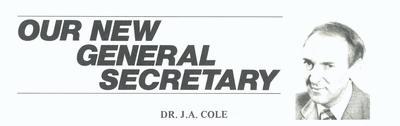
When he was invited to take up the role of General Secretary of the Society in 1979, Jeff was asked why he had accepted. He said that he felt “fortunate in working with a talented and stimulating group of research students who in turn have been helped immeasurably by other microbiologists they have met through the Society. The Society has an abundance of talented members and a tradition of friendly interchange of ideas which brings students cheek by jowl with senior microbiologists. The opportunity to promote further such interchange was irresistible”. More recently, when asked for words of advice for early career researchers, Jeff told them to “understand that there are no limits to what you can achieve in research. The only factors that will restrict you will be your confidence; your ability to work with colleagues; and your appetite for hard work”.
This human approach was typical of Jeff Cole. Among the many recollections of Jeff from members of the Society are contributions to science, to leadership, to organisations and to publications. But equally strong are feelings about Jeff’s personality and humanity. As former President Hilary Lappin-Scott puts it: “I liked him a lot, he had such a wicked sense of humour”.