
Professor Robin Weiss: a tribute
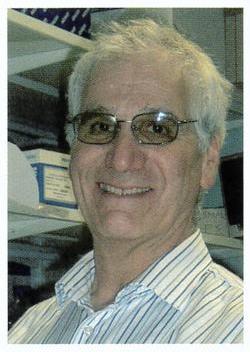
Robin was a long-term member of the Society and as well as serving as President from 2006 to 2009, he was an Honorary Member and the winner of the Marjory Stephenson Prize Lecture in 2015 when his lecture was entitled What’s the host and what’s the microbe?.
A major figure in global virology, Robin is probably best remembered for his significant contributions in the early understanding of HIV and AIDS and his work on microbes and cancer. Friends and colleagues recall his intellectual breadth, passion for science and his dedication to mentoring the careers of many young scientists. He is survived by his wife, Margaret, and by their daughters, Helen and Rachel.
Robin’s formal academic career started by studying Zoology at University College London, followed by work in India as a research assistant, before completing his doctorate in 1969 in the laboratory of Michael Abercrombie. Robin spent formative periods in Prague and the United States and then returned to London to build the scientific career for which he became internationally known. Robin once described himself as working "with one foot in cancer research and the other in infectious diseases," and that dual perspective was a hallmark of his science.
Robin’s early work on avian tumour viruses established one of the key ideas of modern retrovirology: that retroviral genomes can become inherited elements of the host genome. In the early 1970s, Robin and colleagues showed that a factor in chicken cells acting as a helper for Rous sarcoma virus was heritable, work that helped found the concept of endogenous retroviruses. What began as elegant genetics in chickens became part of a much larger story about the long evolutionary traffic between viruses and their hosts. Indeed, the importance of endogenous retrovirus to human health reentered Robin’s career when his laboratory provided critical evidence that pig endogenous retroviruses (PERVs) could infect human cells in laboratory settings, highlighting a significant hurdle for xenotransplantation (using pig organs for human transplantation). This research demonstrated that PERV transmission was a plausible safety concern, forcing the field to address this risk of zoonosis.
In 1980 Robin moved to the Institute of Cancer Research (ICR), serving first as Director and then as Director of Research, whilst enabling his lab to flourish over the next 19 years. Those years were decisive for Robin’s virology, for the ICR itself and for British cancer research more broadly. Colleagues at the ICR later credited him with a bold, interdisciplinary scientific vision at a moment when molecular and cell biology were starting to transform cancer research. The ICR was also where one of Robin’s most widely recognised scientific contributions came about during the HIV/AIDS epidemic. His laboratory played a central part in establishing CD4 as the essential receptor component for HIV entry, a finding that immediately clarified viral tropism and pathogenesis and became foundational for later diagnostics, therapeutic strategies and vaccine research. He also contributed to the study of HIV antibody neutralization, and to one of the first antibody-based screening assays used to protect blood supplies in the UK and beyond. During a period when fear, stigma and misinformation often surrounded the disease, Robin was always a rigorous and determined advocate for evidence and the pursuit of the science.
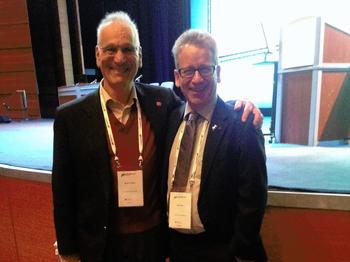
The HIV/AIDS pandemic also allowed Robin and his lab to branch into DNA virology, with the discovery in by Chang and Moore in the USA of Kaposi’s sarcoma-associated herpesvirus (KSHV, also called HHV-8) in Kaposi’s sarcoma (KS), an AIDS defining cancer. Robin’s lab launched the careers of many people into KSHV research, with Robin co-authoring studies using molecular correlates of causation that shifted KSHV from being a suspected association with KS to a biologically plausible cause of the disease. As with HIV, Robin contributed to the early seroepidemiology of KSHV, developed antibody-based approaches which clarified how infection was distributed across populations and strengthening the link between KSHV infection, KS and some B cell malignancies.
In 1999 Robin returned to UCL as Professor of Viral Oncology and Director of the newly established Wohl Virion Centre. Robin continued to work on HIV neutralisation, Kaposi's sarcoma, xenotransplantation and the risks of zoonotic infection, and was also at the forefront of illuminating one of the strangest phenomena in cancer biology: transmissible tumours. His work with colleagues on canine transmissible venereal tumour (CTVT) helped show how a malignant clone could persist as a globally distributed cellular parasite, with the genomes of different CTVTs showing the founder animal of the tumour lived approximately 11,000 years ago, and a global dispersion of CTVT across continents happened approximately 500 years ago, coinciding with the era of rapid human global exploration. This wonderous science reinforced how Robin never accepted boundaries that divide cancer from infection, or virology from wider questions of evolution and immunity.
Leading the tributes to Robin, current President Gordon Dougan said, “I was particularly saddened to hear the news that Robin Weiss recently passed away. He was a previous President of the Society and served us and the broader scientific community superbly and tirelessly. I first met Robin when he became a consultant for The Wellcome Foundation in the 1980s, as we became aware of the scale of the AIDS epidemic and began to design interventions. I was working at the company in Beckenham at the time and became involved myself in several AIDS related programmes. As a virologist, Robin and his team helped define the role human CD4 antigen plays as a receptor for HIV-1 virus. He was right there at the cutting edge. He advised Wellcome, then an independent pharmaceutical company owned by The Wellcome Trust, and contributed to both anti-viral development and diagnostics. His huge talent and experience were invaluable. I went on to interact with him at numerous meetings, often speaking in the same sessions. We were also on the same grant and trustee boards. Others will provide more details on Robin’s career, but I remember him as that classically brilliant scientist we all looked up to. He will be missed.”
Treasurer-Elect of the Microbiology Society Paul Kellam, who knew Robin very well recalls his early life: “Robin was born in London in 1940, growing up in a family shaped by exile and the resilience that can create. In an interview for the Microbiology Society, he recalled that both his parents had grown up in Germany and came to Britain as refugees after Hitler's rise to power. To understand more of Robin’s intellect and values, one of the most tolerant and thoughtful people I have ever met, I would highly recommend reading the article. In his 2015 Marjory Stephenson Prize Lecture, Robin asked, "What's the host and what's the microbe?" a typically Robin Weiss question: precise, provocative and wide open to discovery, a fitting epitaph for a scientist who spent his life dissolving boundaries and revealing deeper biological connections. One durable part of Robin’s legacy lies in the scientists he trained and encouraged, and I was one such fortuate scientist. Robin asked me my first ever question at a scientific meeting when, as a PhD student, I presented my work at the Society’s 119th Ordinary Meeting at University of Edinburgh in 1991 . Robin was my PhD examiner, sponsor and host for my ICR research fellowship and a mentor for many parts of my career. Robin and the lab he created has influenced me in immearsuable ways. Microbiology has lost one of its great integrative thinkers: a virologist of unusual breadth, a leader of institutions, and a mentor whose inspiration will persist in lives of everyone who met him.”
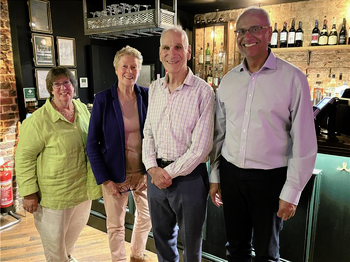
Former President of the Microbiology Society Hilary Lappin-Scott remembers, “I had the pleasure of working with Robin on the Microbiology Society Council during his Presidency. At that time the Society recognised that it wanted to greatly strengthen virology within all of its activities. Robin was duly elected and did an excellent job to champion virology, alongside strengthening and growing the Society under his leadership. He had a warm, friendly style of chairing meetings and this enabled much progress to be made. I learnt a great deal from him and enjoyed working with him, he was a strong mentor and very caring. I have met him several times over the last years and his enthusiasm and promotion of microbiology and early career scientists was truly inspiring.”
Mark Harris, a former General Secretary of the Society, said “Robin was the archetypal ‘gentleman scientist’. He was hugely respected throughout the fields of virology and cancer biology for his academic achievements, a highlight being his role in the discovery of CD4 as the HIV receptor which put him and his laboratory firmly in the vanguard of HIV research. He combined his enthusiasm for the subject with a genuine interest in the contributions of others. Above all he was a passionate supporter of young investigators, always providing encouragement and sage advice. I last met him at his 80th birthday symposium at UCL, where, despite the fact that there were several hundred people in attendance, he still found the time for many individual conversations.”
Honorary Member Dave Rowlands, who knew Robin for decades, recalls, “It was sad to learn of the recent passing of Robin Weiss after a lifetime of massive achievements in the field of retrovirology, especially HIV and cancer biology. His scientific achievements are well known and fully accessible but it might be worth reflecting on his broader achievements as a thoroughly decent human being. I got to know Robin over many decades, mainly at Microbiology Society meetings, and was always impressed by his natural curiosity and his broad and deep knowledge of both virology and biology generally. I got to know him better when he invited me to be a member of the administration board of a Gates Foundation grant he was awarded to investigate approaches to develop broadly cross reactive vaccines against HIV. Although not a retrovirologist myself I found this a fascinating and highly educational experience. What I was especially impressed by was Robin’s unwavering support for his staff and colleagues. This can be illustrated by his annual production of hand picked and produced blackberry jam for distribution to the families of his students and colleagues. I have personally observed his adoption as an “honorary Grandfather” to his colleague’s offspring. It was during informal chats during this period Robin and I realised that we had together sat the entrance exam for University College, London, in 1958.”
As part of the Society’s celebrations of its 70th anniversary in 2015, we celebrated 70 of the most interesting and important papers from the archive of our journals, and Robin was invited to make the selection of 15 articles from Journal of General Virology. “I was given carte blanche which ones to choose,” he wrote before apologising to anyone whose favourite had not made the list: “Please consider the odds”. His diverse interests showed in his choices. He wrote of “remarkable papers” with thousands of citations, “the first thorough analysis of Ebola virus,” an early sequencing paper, and pioneering studies of antiviral drugs and resistance to them. “Overall,” Robin concluded, “Journal of General Virology has published a wide range of important and interesting discoveries”.
When he gave his Marjory Stephenson lecture, covering decades of discoveries, Robin was careful to remember everyone who had been part of his scientific journey. “I am most grateful to my post-doctoral mentors,” he wrote, thanking Jan Svododa with whom he had worked in Prague in the late 1960s and Peter Vogt, whose lab in the USA was his base in the early 1970s. What he remembered most was “a stimulating intellectual environment”.
Just a few months ago, immediately after the Society’s Annual General Meeting, Robin sent a short email that typified both his commitment to the Microbiology Society and his human approach, “I wish to thank you, the President, Treasurer and your staff for a brisk and efficient online AGM. Carry on the good work!”
Robin was recognised through many awards and fellowships. He was elected to EMBO, became a Fellow of the Royal Society in 1997, became a Fellow of the Academy of Medical Sciences in 1998, received the M. W. Beijerinck Prize for Virology in 2007, was awarded the Ernst Chain Prize for his pioneering HIV research, and in 2008 was awarded the Gregor Mendal Medal from The Academy of Sciences of the Czech Republic. Within the Microbiology Society, Robin’s presidency and later Marjory Stephenson Prize in 2015 honored not only scientific distinction but a long-standing commitment to the wider microbiology community.