
Protect our future: youth against antimicrobial resistance

It was a happy moment for me when I received an email from Ffion Lane (Member Engagement and Community Inclusion Manager), approving my proposed AMR awareness activity for WAAW 2025. It was a much-anticipated activity because I had informed the school of the project, they had approved the programme, and we were eagerly awaiting the result of my application, to determine whether we could go ahead, or not. So, the news of the approval was the catalyst that sprang everyone into action!
There were a few challenges I anticipated initially, relating to the location of the activity. The selected school was in Ibadan, while I am based in Lagos, and I needed some active volunteers on the ground who were based in Ibadan (but most of my contacts are based in Lagos). Transportation between Lagos and Ibadan was also a big problem, but I was determined to host an activity that would create a lasting impression on the students and community, irrespective of these challenges.
The activity was aimed at stimulating interest in AMR among students, who could then share the message with their families. This approach was chosen because the younger generation have a quest for knowledge, and their social media activity can be used to get them involved in creating awareness of AMR. The theme for the WAAW 2025 was ‘Act Now: Protect Our Present, Secure Our Future’. This resonated with me and encouraged my involvement of the youths, who are leaders of tomorrow. We, therefore, created our local sub-theme of ‘Protect our future: Youth against antimicrobial resistance’.
To start with, I created a WhatsApp group for the volunteers. They were based at the school and would assist in selecting the best among the students. It was a daunting task because virtually all of the students were excellent in academic performance and were qualified for the exercise, however, we needed to select a few to participate in debates and a quiz competition.
I invited two speakers, who complimented the debates and quiz competitions. A total of 12 students participated in the debates, with six students per topic. The debate was engaging and revealed the depth of knowledge of the debaters. The quiz competition was also interesting, with an extra round of debates conducted to select the three winners. All those who participated in the debates were given small gifts. The funding for gift items and refreshment was provided by the Society and was also supported by the school management, because we had 120 students in attendance, which was more than we had budgeted for. The Society also provided additional support by sending branded pens and fluffy bugs, which were distributed on a first come first served basis.
Highlights
Two talks, which lasted 30 mins each were presented plus, there were two debates and one quiz competition:
- Olumuyiwa Alabi (University of Ibadan, Nigeria) presented ‘Antibiotics and Us’, delving into the definition, uses and abuses of antibiotics.
- Oluwatoyin Fatumbi (Ojoo High School, Nigeria) spoke on the use of antibiotics in agriculture and warned students to take the message home to their parents and guardians.
- The first debate was: antibiotic misuse by individuals is the main driver of antimicrobial resistance.
- The second debate was: banning antibiotics in livestock farming is necessary to protect human health
- The quiz competition covered the basics of antimicrobials, causes of antimicrobial resistance, as well as prevention and stewardship.
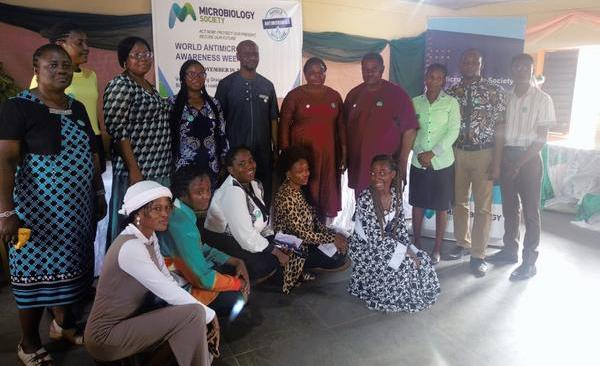
WAAW 2025 volunteers and members of school management
Did the event meet its initial aim?
Yes, the event met its initial aim. Feedback from students and other attendees highlighted that the activity was timely and impactful. A significant number of students also indicated a preference for career paths in the biological and life sciences.
“The awareness has created a lasting impression on me as a future scientist, so I will know how to address the issue of AMR, and I strive to be a global ambassador in campaigning against abuse of antibiotics” Amazing Grace Comprehensive College student
Feedback from staff and volunteers called for similar programmes in the future, to include more than one school in the region, because the talks and debates had an impactful effect on everyone. Some attendees were not well informed about the consequences of AMR prior to the activity but became more educated due to the programme. Two volunteers actually admitted to abusing antibiotics in the past but confirmed they would not anymore.
Lessons I learned from organising the workshop
I knew there would be challenges, as stated earlier, but my drive for success provided the motivation to ensure the event went well.
Working as a team ensured great success. We worked together and had initial meetings via WhatsApp, carrying out all delegations and logistics online and as a team, so we had a hitch-free event.
The students’ commitment and drive were beyond my expectations. They carried out thorough research and provided interesting responses during debates, including giving real-life examples based on the situation in Nigeria.
Find out more about the Champions Scheme and the activities our Champions undertake on our Society Champions page.