
When the invisible took centre stage: celebrating International Microorganism Day 2026

What if we could see the world that is always around us but almost never visible? A world of bacteria, viruses, fungi and countless other micro-organisms – some that cause disease, some that protect us, some that transform our environment and many that hold possibilities for the future of science and healthcare.
On 17 September 2026, the Department of Medical Laboratory & Life Sciences, Parul Institute of Allied and Healthcare Sciences (PIAHS), Parul University, India, brought this invisible world into the spotlight using International Microorganism Day 2026 (IMD26). With the theme ‘Micro world, macro impact: Microorganisms and the future of health and environment’, the event was designed not simply as a celebration of microbiology, but as an opportunity to make microbiology visible, engaging and meaningful.
From the invisible to the unforgettable
Microbiology is often introduced through microscopes, culture plates, staining techniques and laboratory protocols. But the impact of micro-organisms extends far beyond the laboratory. Microbes influence human health, food, ecosystems, biotechnology, climate, agriculture and virtually every aspect of life. Understanding them, therefore, requires more than memorising names and pathways – it requires curiosity.
That was the spirit behind IMD26. The event brought together expert perspectives, student enthusiasm and a variety of creative and scientific activities. The day began with an engaging expert interaction session, featuring insights from senior academics and researchers working across microbiology, biotechnology and allied health sciences. Devarshi Gajjar (Maharaja Sayajirao University of Baroda, India) and Anuradha Nerurkar (Maharaja Sayajirao University of Baroda, India) brought decades of academic and research experience to the discussion, offering students a rare, grounded view of how the field has evolved. They were joined by Ankita Doshi (Navrachana University, India), who shared their own perspectives from the classroom, the lab and the clinic.
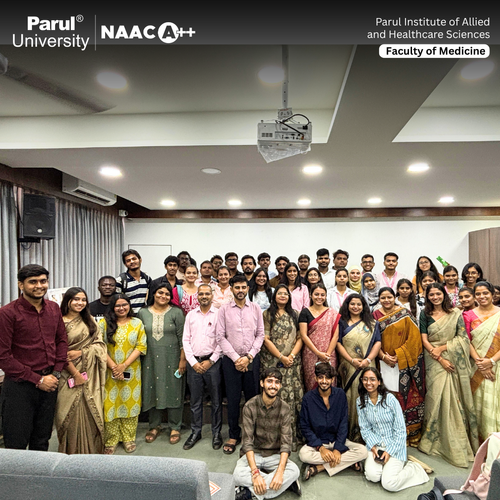
Together, their discussions opened up a broader view of micro-organisms: one that moved beyond pathogens and disease to explore emerging challenges, scientific innovation, healthcare applications and the future possibilities of microbiology. For students, it was a reminder that the microbial world is not just something to study for an examination. It is a field full of unanswered questions and opportunities.
When learning became an experience
One of the most rewarding aspects of IMD26 was seeing microbiology move beyond the conventional classroom. The afternoon transformed into a celebration of knowledge, creativity, skill and teamwork, with a series of student competitions designed around the microbial world.
From the excitement of the microbiology quiz to the precision required in the staining techniques skill competition, students were encouraged to demonstrate both what they knew and what they could do. The model-making and face-painting competitions brought creativity into science, while the personal protective equipment (PPE) and handwashing activity connected microbiological concepts with everyday infection prevention. The rangoli competition offered another creative interpretation of microorganisms, while the Microorganism QR Hunt turned learning into an interactive exploration.
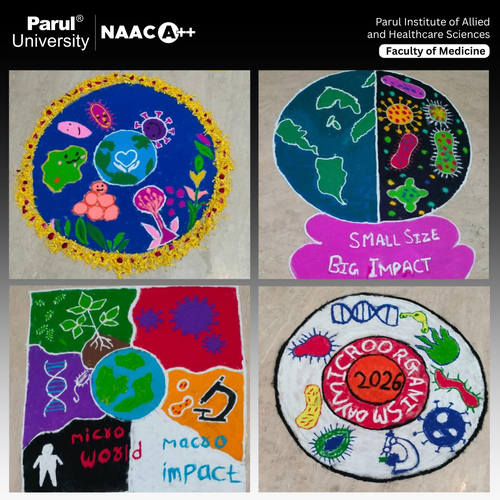
Each activity approached microbiology differently. And perhaps that was the most important lesson of the day: science does not have to be communicated in only one way.
Sometimes it is understood through a microscope.
Sometimes through a question.
Sometimes through a competition.
Sometimes through art.
And sometimes through simply being curious.
More than an awareness day
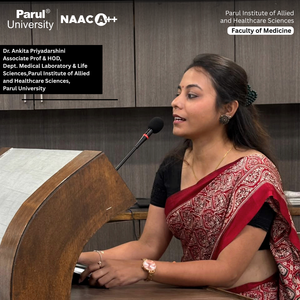
One of the aspects I value most as a Society Champion is the opportunity to take microbiology beyond the boundaries of routine academic activities and create spaces where people can connect with the subject in new ways. The Champions Scheme initiatives similarly emphasise taking microbiology to different communities and using engaging, participatory approaches to make complex microbial concepts accessible.
IMD26 reinforced that idea for me. When students participate actively, they don't simply receive information – they question, create, collaborate and communicate. And when they do that, microbiology becomes much more than a subject. It becomes a way of understanding the world around us.
The power of the microscopic world
There is something fascinating about micro-organisms. They are too small for us to see with our naked eyes, yet their influence is enormous. A micro-organism can cause an outbreak, help produce a life-saving medicine, transform waste, contribute to food production, alter an ecosystem or become a powerful tool in biotechnology. The contradiction is extraordinary: the smallest organisms can create some of the biggest changes.
That is precisely why conversations around microbiology matter. As healthcare systems face emerging infections, antimicrobial resistance, environmental challenges and the need for sustainable technologies, understanding micro-organisms becomes increasingly important. But scientific progress does not happen through laboratories alone. It begins with curiosity. It grows through education. And it becomes meaningful when knowledge reaches people.
A celebration powered by people
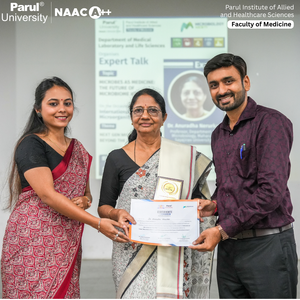
IMD26 would not have been possible without the collective efforts of our students, faculty members, the organising team, volunteers and collaborators. The enthusiasm of the students was particularly inspiring. Their participation demonstrated that when young minds are given the opportunity to explore science creatively, they can transform an academic event into a genuine celebration of learning.
I am deeply grateful to everyone who contributed to making this day possible, especially our experts – Devarshi Gajjar, Anuradha Nerurkar and Ankita Doshi – along with our faculty colleagues, student participants, volunteers and the organising team.
A special appreciation goes to Hemant Patadia (Parul University, India) for his support and encouragement, and to everyone who worked behind the scenes to bring the vision of IMD26 to life.
Looking beyond IMD26
Perhaps the most important outcome of an event like International Microorganism Day is not what happens on the day itself. It is what happens after:
- Will a student look differently at a culture plate?
- Will someone become curious about the microbiome?
- Will a participant think differently about infection prevention?
- Will a student discover an interest in microbiology research?
- Will one conversation inspire someone to pursue a scientific question?
If even one of these things happens, the celebration continues long after the auditorium becomes quiet.
IMD26 reminded us that microbiology is everywhere. Its future belongs not only to scientists in laboratories, but to curious minds willing to explore it. As we look back at the conversations, competitions, laughter, learning and countless memorable moments from the day, one message remains clear: we may not always see micro-organisms, but we live in their world, and their world is shaping ours. So, let us continue to explore the unseen, discover the extraordinary and celebrate the microbial world. Because sometimes, the smallest things leave the biggest impact.
Find out more about the activities our Champions are organising on our Champions events and activities page.