
World Refugee Day: Sara Albagir Abdalla Mohammed
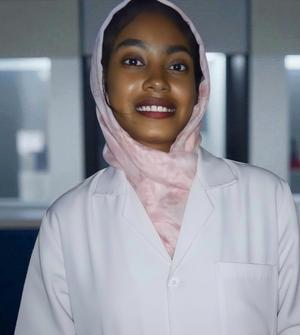
I am a medical microbiology student in Sudan, and for a long time, I was not sure that sentence would ever be true again. In April 2023, the conflict displaced me from my home, and with it, from almost everything that made up my academic life.
In the months after, once the first weeks were behind me, and I started thinking past immediate survival, I began trying to reach my teachers – to find out whether there were any plans to resume or whether the university had any arrangements in place. Getting in touch with professors was either extremely difficult or impossible. The few I managed to reach had been displaced themselves, or had already left the country. My university campus was in an active conflict zone, and the university where I'd spent the last several years was suddenly unreachable.
The conflict was also spreading. States that had initially seemed safe became conflict zones almost overnight, and I was aware that safety was not guaranteed in the place I had moved to either. As the months went on, I moved gradually from hoping my education would resume soon, to seriously questioning whether it would resume at all. Somewhere in that period, I started to believe that the years I had already invested might simply come to nothing. That if I ever returned to studying, I would have to start from zero – after being on the verge of graduation. I had no way of knowing whether my university would reopen, whether my academic records were intact, or whether there would be anything left to return to. The uncertainty had no clear end point, because the conflict itself had none.
There is something else I want to name, because I think it is more common among displaced students than it is ever acknowledged. When the people around you are losing their homes, their relatives and sometimes their lives, it feels almost indulgent to be grieving your education. A kind of guilt takes hold – you are worried about your degree, your career and your future, while others are worried about whether they will survive the week. While both are real losses, the scale of suffering around you makes your own feel too small to speak about.
My experience is not unusual. Across Sudan, thousands of students and researchers found themselves in some version of the same situation – cut off from their universities, their supervisors, their laboratories and the professional networks that a scientific career depends on. For many, the disruption has not lasted weeks or months. It has lasted years. Degrees remain unfinished. Research projects have stalled. Students who were close to completing their training have had to pause indefinitely. What displacement takes from a scientist is not only lecture notes or access to a library but also the laboratory equipment you cannot carry with you and the training that happens around it – the scientific judgement that develops only through supervised practice and cannot be replicated online. It is time – and in a competitive field where careers are built incrementally, lost years do not just delay a career; they reshape it.
There is another consequence that receives far less attention. Many graduates from universities affected by the conflict – people who had already completed their degrees – have been unable to move forward in their careers not because they have not finished their studies, but because they cannot access proof that they have. University administrative systems in Khartoum, as well as in most other regions directly affected by the war, were entirely campus-based, with no online equivalent. When campuses became inaccessible, so did student records, transcripts and the official documentation that connects a qualification to a career. Graduates trained in healthcare and laboratory science have been unable to register with professional bodies, unable to apply for postgraduate programmes and unable to practise the professions they spent years preparing for – because they could not obtain the documentation.
This has been the situation since April 2023, and in some universities, it is still ongoing to this day. For some graduates, the interruption has lasted almost as long as the degree itself normally takes to complete. The financial consequences are tangible: years of lost income and families who invested in an education that cannot yet be put to use. And beyond the financial, there is what it actually feels like to have met every requirement, to have finished, and still not be able to move forward. The war did not only prevent people from completing their education. In some cases, it arrived after they had already finished and still found a way to hold them back.
Despite all of this, students and scientists found ways to keep learning. Many stayed in contact with their field through online seminars, peer study groups and networks that continued functioning across the distances displacement had created. Scientific societies and professional organisations kept some people connected to training, mentorship and the scientific communities they had been separated from. None of these can replace a functioning university, laboratory or clinical training environment, and many students had no access to even these alternatives. But for those who did, it was a way to keep moving when everything else had stopped.
World Refugee Day draws attention to the most visible consequences of displacement – the loss of home and safety. These are real, and they are urgent. But displacement also reaches into things that are harder to see: the education interrupted before completion and the career blocked even after it.
We tend to think of displacement as a crisis with a clear end. The conflict stops, people return home and the emergency is over. For many students and scientists in Sudan, that has not been the reality. Where fighting continues, campuses remain inaccessible and with them the records and documentation they hold. Even where the conflict has subsided, the disruption often persists. Administrative systems take time to recover, records remain difficult to access and students and graduates can find themselves waiting years; some to resume an education that was interrupted, others to make use of one they had already completed. A degree may have been earned, but the transcript that proves it remains out of reach. The knowledge is there, and the qualification exists. What this conflict has taken is the ability to demonstrate either.
These, too, are part of what it means to be displaced – not only from a home but also from a scientific career and the years that should have been spent building it.
If you would like to support academics who have been displaced, read our previous blog from Cara (the Council for At-Risk Academics).