
LGBTQ+ STEM Day 2026: Lewis Kelly
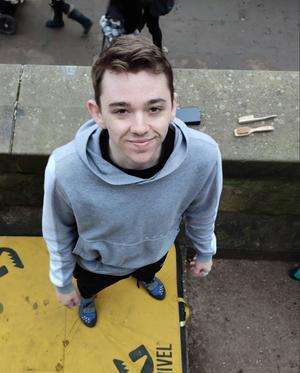
Could you tell me a bit more about yourself?
Hi, my name is Lewis (he/him) and I identify as Bisexual. I am an early career researcher and currently a second-year MPhil student at the University of Strathclyde in Glasgow, UK. My research focuses on the possible effect of prophage regions on bacterial pathogenicity and survival, focusing on a commensal organism (Enterococcus faecalis). I am particularly interested in understanding the factors that influence bacterial adaptation and survival, and how this knowledge can contribute to improving health outcomes.
Before joining the University of Strathclyde, I completed an MRes focusing on AMR and plasmid stability at the Liverpool School of Tropical Medicine, UK. It was during this time that I first joined the Society and attended an LGBTQ+ social, which inspired me to become more involved and eventually help organise the following Annual Conference LGBTQ+ social.
Outside the lab, I enjoy spending time outdoors, particularly camping, hiking and climbing, and I am always keen to try new hobbies and challenges.
It’s LGBTQ+ STEM Day on 18 November; are you doing anything this year to raise awareness?
Unfortunately, I was not aware of the day until recently so other than completing this interview I have nothing planned. I will try to interact next year by attending an event such as one of the Pride in STEM events I saw advertised online recently.
Could you tell us about your experience in academia, as someone who is openly part of the LGBTQ+ community?
I think I have been lucky and my identity has not impacted my experience in academia. I originally didn’t come out and kept my work and personal life separate, I think in order to avoid any prejudice and possible issues. However, when I did come out, I was lucky enough to receive lots of support and made to feel welcome and included, so did not need to worry. I have always since been open about my sexuality and have been fortunate to never have any direct issues. Attending the LGBTQ+ social the last two years and meeting other LGBTQ+ scientists has definitely made me more relaxed and confident in being who I am, along with the friends and colleagues I have made during my academic journey so far.
Have you experienced any bias or prejudice in academia as a result of your LGBTQ+ identity?
Luckily during my academic journey so far, I have faced no prejudice due to my identity. I was fortunate enough to travel overseas for a summer placement during my undergraduate degree, to a country where acceptance was lower, and I made the decision to be less open about my identity. This was a great insight into how prejudice could occur in remote areas, but fortunately the teams I worked with were supportive and never made any comments or prejudice. This also gave me the experience of understanding health inequalities and the effects of people’s identities on seeking treatment where acceptance is lower.
While I haven’t experienced direct prejudice in academia, the experience made me aware that acceptance cannot always be taken for granted. It highlighted the additional considerations other people may face in different cultural settings. It also reinforced the importance of inclusive environments, visible role models and supportive colleagues, as these can have a significant impact on whether people feel comfortable being authentic.
Could you tell us more about your research?
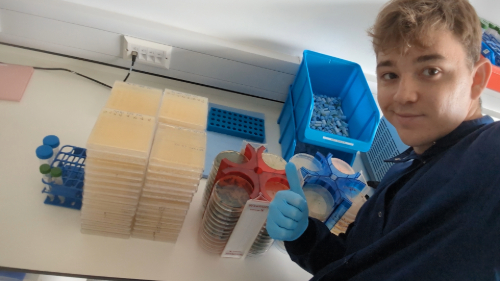
My research combines laboratory investigation and bioinformatic analyses to investigate the role of viruses that infect bacteria, bacteriophages, on the pathogenicity of bacteria. The focus is on the impact of a specific prophage region on the prevalence of hospitalisation linked to Enterococcus faecalis. In the laboratory, I have generated a knockout mutant, and I am investigating how the loss of a prophage region affects bacterial growth, biofilm formation, phage biology and pathogenicity compared to the wildtype strain. Alongside this, I analyse a large genomic dataset from hospitalised and non-hospitalised individuals to determine how common the prophage regions are within E. faecalis carriage and whether its presence is associated with adaptation to clinical environments. Ultimately, the project aims to improve our understanding of how bacteriophages influence bacterial behaviour and contribute to the emergence of clinically important E. faecalis lineages.
What advice would you give to LGBTQ+ individuals who are considering a career in in STEM?
My main advice would be to be open and honest about your identity, where it is safe and comfortable to do so. Being able to bring your authentic self to work can boost your confidence and help you build meaningful professional relationships.
At the same time, it is important to recognise that not every environment is equally inclusive. If you find yourself in a setting where you don’t feel comfortable being open, seeking out support and building networks can make a huge difference. There are many fantastic communities, professional networks and allies across STEM who can provide advice, mentorship, and a sense of belonging.
Finally, for people considering a career in STEM or those early in their academic journey, don’t let fears about fitting in discourage you from pursuing a career in STEM. Diverse perspectives strengthen research, innovation and problem-solving. Having a supportive network and the confidence to be yourself can make a significant difference throughout your academic and professional journey.
For those already in their careers and higher up, seeing LGBTQ+ researchers and academics in senior positions can be incredibly encouraging. Don’t underestimate the impact that being visible and authentic can have on those who come after you.
What has been the highlight of your career so far; and what do you hope to achieve in your career in the future?
My biggest career highlight so far has been the opportunities I have had to step outside my comfort zone and embrace new experiences. I have been fortunate enough to work with a variety of research groups and collaborate with talented researchers at all stages of their careers; each of whom has helped shape my development as a scientist.
One experience that stands out is the placement I completed during my undergraduate degree. It was the first time I had been exposed to so many new challenges and opportunities, and it significantly boosted my confidence. It showed me that, with determination and the right support, I can achieve goals that once felt out of reach.

Recently, my career has taken a different direction, and I am excited to explore where it leads. Alongside opportunities in academia, I am considering careers beyond the traditional academic pathway, particularly in diagnostic laboratories. I am also interested in conservation, an area I was passionate about growing up and one that still appeals to me today.
Ultimately, I hope to make a meaningful contribution to biology while continuing to support initiatives that help others feel welcome, valued, and able to be authentic and included within the STEM field, regardless of identity.
You became an organiser of the Society’s LGBTQ+ Annual Conference social last year. How have you found the experience so far?
The experience has been rewarding. One of the highlights has been hearing the positive feedback from the 2026 event and seeing how much it means to members of the Society. Creating a space where people can connect, network and share experiences with others across academia and industry, from early career researchers to professors, has been especially meaningful.
It has also been personally valuable. Being involved in organising the event has helped build my confidence, strengthened my sense of belonging within the academic community, and reinforced the importance of providing visible and supportive spaces for LGBTQ+ researchers. Seeing the connections and friendships that develop from these events makes the experience worthwhile.
There are lots of networks available for LGBTQ+ academics, scientists and microbiologists. Pride in Microbiology is one such network which the Society works closely with; they provide online networking and events for the community.