The London Infection Network for ECRs 2026 symposium
Five years ago, we did not think we would be here. When we got together in 2021, as a handful of postdocs, to start the London Infection Network for ECRs (LINE – at the time called London Infection Postdoc Network ‘LIPN’), we wanted to build a space where postdocs could connect at seminars and smaller networking events. On Monday 22 June 2026, we were setting up for our fourth full-day symposium, having extended our reach to all ECRs, and slowly but steadily growing recognition outside of London.
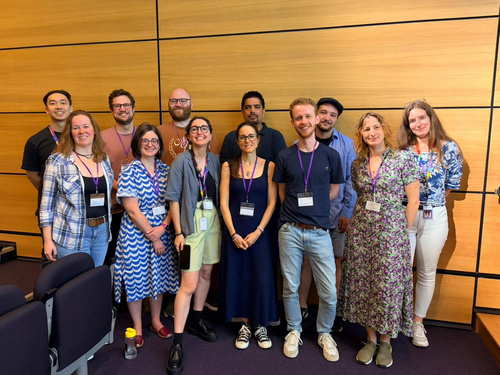
The LINE organising committee. From left to right, top to bottom: Jakson Luk, Will Pearson, Tom Williams, Oscar Torres, Baptiste Pradel, Anita Atanasova (Francis Crick event team), AK Reuschl, Cristina Venturini, Marion Delphin, Julia Sanchez-Garrido, Jorn Stok and Josephine Nemegeer.
We got to the Francis Crick Institute early to set-up the registration desk and exhibition space, welcoming sponsors and poster presenters. As with every year, anticipation was running high while we waited for our first attendees and speakers to arrive. As the auditorium filled, we saw exactly what we'd hoped for: the virologist from University of Oxford, UK, chatting to the parasitologist from Imperial College London, UK – ECRs that had not met before striking up conversations. This was already an early sign of what the day was going to deliver: a celebration of ECR science and the building of networks.
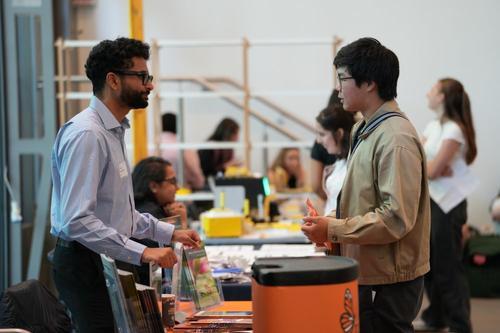
Attendees interacted throughout the day with our sponsors.
Every year, we invite early career principal investgators (PIs) to share their scientific excellence and career inspiration with our attendees. This year, we had the privilege of hosting Jonathan Maelfait (Ghent University, Belgium), who delivered the plenary talk on Z-nucleic acids in antiviral immunity, revealing new ways of thinking about innate immune activation during viral infections. Meera Unnikrishnan (University of Warwick, UK) concluded the day with her keynote, Exploring bacterial mechanisms at host–pathogen interfaces, sharing insights into the crosstalk between pathogens and their tissue niche.
At the centre of the symposium are the selected oral and poster presentations by ECRs, covering cutting-edge research, spanning from bacterial infections, fungal diseases and viral pathogenesis to antimicrobial resistance. Let’s just say that selecting presenters was an especially difficult task for our committee this year, given the large number of high-quality abstracts submitted. This led to a stride of amazing talks and posters, which left us with lots of food for thought and discussion! Luckily for us, the best presentation awards were selected by an audience vote. The recipients of the LINE awards this year were:
- Priyanka Biswas (Imperial College London, UK) for a talk on how Primary colitis imprints define long-term intestinal resilience and vulnerability
- Mohamed ElGhazaly (Queen Mary University of London, UK) with a talk about how Viral manipulation of epigenetics regulates immune sensing
- Celine Driessen (Imperial College London, UK) for a poster about Investigating the pathoadaptive evolution of nitrate utilisation in high-risk multidrug-resistant clones of Klebsiella pneumoniae
- Marta Oliveira (Queen Mary University of London, UK) for a poster on how HIV-1 Vpr drives targeted chromatin remodelling and transcriptional reprogramming in resting CD4 T cells
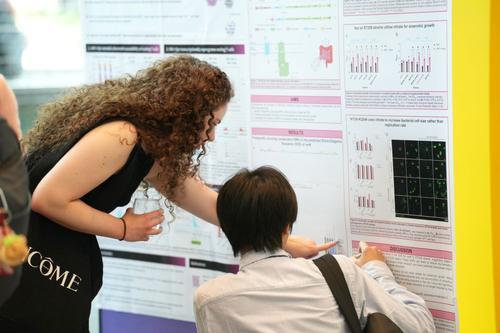
The ECRs went deep into the details during the poster session!
As part of this day of ECR science, we want to give our attendees the opportunities to expose themselves to different career trajectories. For this, we curate a diverse and broad career discussion panel every year. This year, we hosted Freddy Green (Public Engagement Content Developer), Sarah Laverty (Senior Consulting Analyst), Pierre Maillard (Senior Lecturer), Tatiana Rizou (Clinical Trial Manager), Jessica Rowley (Flow Cytometry Facility Manager) and Jess Thompson (Senior Editor). The panel discussion gave everyone a window into what these roles look like day to day, shedding light on career paths that can often feel like a bit of a mystery from the lab bench. It was fantastic to hear what everyone loves about their job, though the mention of ‘meetings’ got quite a laugh: while some panellists genuinely enjoy them, others admitted they would gladly skip them altogether! Audience engagement was so high that we ran out of time long before we could get through every question, with discussions carrying straight on into the networking reception.
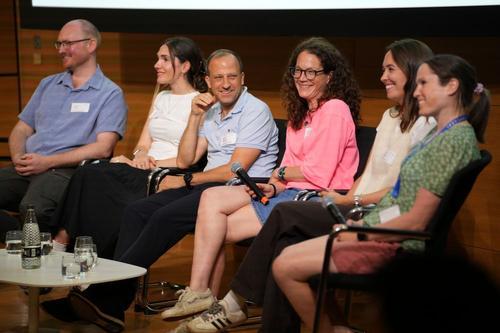
The career panel really connected with the audience whilst answering questions and shared inspirational tips for their future. From left to right: Freddy Green, Sarah Laverty, Pierre Maillard, Jess Thompson, Tatiana Rizou and Jessica Rowley.
This year, following the launch and success of our new LINE+ seminar series, which aims to inspire ECRs and show where science can take us beyond the bench, we included a LINE+ talk given by Hepatitis B virus health advocate Supa Chantschool (HepBCompanion, UK). Patient representation in research settings and study design is often overlooked or poorly understood. In light of this, Supa shared his experiences in a talk titled Best practices for scientists to engage with affected communities: chronic hepatitis B as a case study. ECRs had the opportunity to interact with him during lunchtime to learn more about his work and outreach.
With our symposia and seminars, we aim to increase ECR visibility and foster ECR development. We believe that keeping the programme of the day versatile creates a vibrant atmosphere in which we all can thrive and get inspired. The feedback from our symposium was clear: we were successful in our mission to create an inclusive, supportive community for ECRs in the UK. At times when science faces increasing challenges, these connections become vital for advancing research through shared knowledge and collaboration.
Our event received support from the Microbiology Society through a Society-Supported Conference Grant and several industry sponsors. This allowed us to keep registration free and provide travel and carer grants for our attendees to ensure accessibility to everyone. The Microbiology Society’s support was essential in making the symposium a success. The Society-Supported Conference Grant supported both our invited speakers and our ECR attendees, letting us bring in voices from further afield, while keeping the day genuinely accessible to everyone who wanted to be there. It also put the symposium in front of ECRs across the Society's own networks, well beyond our usual circles. Applying was refreshingly painless and communication with the Society was easy throughout, which counts for a lot when we have to fit organising the event around full-time research.
We could not be prouder of what we achieved with this symposium. We managed to maintain the format that has proven effective in previous years while evolving through community feedback, demonstrating LINE's commitment to serving the infection biology research community in London and beyond. We are extremely grateful to the ECRs who presented, attended and without whom it would not have happened. We are already working on the fifth edition but, in the meantime, you can follow LINE on LinkedIn or Bluesky and/or join our seminars throughout the year to stay updated.
If you are interested in applying for a Society-Supported Conference Grant, the next deadline is 1 October 2026. Find out more about that, and the other grants the Society offers, on our All grants webpage.