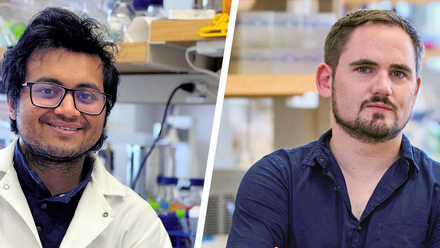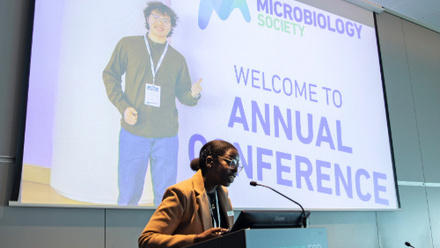
Meet the 2026 Outreach and Engagement Prize Winner, Dr Lindsay Broadbent
About Swathi:
I’m a Research Fellow in the Courtney Influenza Laboratory at Queen’s University Belfast, and my research focus lies at the interface of viral RNA regulation and condensate biology. Interviewing Dr. Lindsay Broadbent for this feature has been a particularly resonant experience for me as I navigate the foundational years of my own journey in science communication. It is inspiring to trace the footsteps of a researcher whose advocacy also took root here in Belfast and this opportunity provided not only a professional masterclass in science communication but also a timely reminder of its impact on the wider community.
Congratulations on receiving the Outreach and Engagement Prize 2026. Receiving this award in Belfast must be very meaningful to you. Could you reflect on how your time at Queen’s University Belfast shaped your journey as a science communicator?
My time at Queen’s University Belfast was transformative, teaching me that being a scientist is only half the battle, and the other half is effectively communicating that work to the rest of the world. In any scientific career, communication isn’t just an elective skill but an essential professional responsibility. My introduction to public engagement was driven entirely by the vibrant community of PhD students and postdocs in Belfast. It was my colleague, Dr. Connor Bamford, a long-standing figure within the Microbiology Society, who encouraged me to join STEMnet during the first year of my doctoral studies. STEMnet serves as a vital bridge in Northern Ireland and across the UK, connecting researchers with outreach opportunities such as school fairs and science festivals. This initial experience sparked a lifelong passion. While my approach to science communication has evolved over the years, I credit those early school science festivals in Belfast for providing the foundation of my interest in science communication.
How have your outreach and engagement activities shaped or redirected your research questions around virus–host interactions and chronic lung damage?
It is an insightful question and one that I have been focusing on lately. Engaging in outreach has fundamentally shifted the trajectory of my research towards a more translational approach. Currently, my focus is centered on how viruses can contribute to long-term complications and chronic lung damage. This shift was heavily influenced by my work with patient advocacy groups, particularly those focusing on Respiratory Syncytial Virus (RSV). Speaking with parents whose children have suffered from severe respiratory infections offers a perspective that experiments don’t. It forced me to evaluate the real-world consequences of our data. In the lab, it is easy to become hyper-fixated on discovery-based science, uncovering niche mechanisms of action. While that "puzzle-solving" is vital and rewarding, advocacy work serves as a constant reminder that there is a patient at the other end of every experiment.
During your media appearances, how did you navigate communicating scientific uncertainty while still delivering clear, actionable messages, and translating complex technical information into content that resonated with non-specialist audiences?
Science communication during a global crisis like COVID-19 pandemic was certainly challenging. It required a constant balancing act between delivering nuanced and evolving data whilst addressing the public’s need for reassurance, two things that do not always align. Effective science communication starts with a deep awareness of your audience. That connection dictates everything from the technical depth of your message to the level of empathy you lead with. One of my most important realizations as I’ve grown in this role is that you can’t pander to people or talk down to them but engage with your audience as peers. When you speak to people like they understand you and commit to stripping away the jargon, you build a foundation of mutual respect that makes science much more accessible. Fostering a relationship where the audience feels respected is important to build their trust in the expertise being shared.
However, a significant part of science communication is also recognizing where your efforts are most impactful. I am frequently confronted with deep-seated skepticism, from lab-leak theories to the denial of viral existence. I have realized that our role is not necessarily convincing those who have already made up their minds and explicitly state that no amount of evidence will change their view. Instead, the real impact lies in reaching the listeners who are still open to information. By directing communication toward those seeking clarity rather than those entrenched in a position, we can ensure our advocacy truly resonates.
Alongside national and regional media appearances, you’ve also been involved in a wide range of outreach activities from the Northern Ireland Science Festivals and Pint of Science to Bright Club and school events. Which format do you find to be the most rewarding and/or the most challenging for public engagement, and why?
Interestingly, the most challenging, rewarding, and occasionally terrifying experiences have all been at events when working with children. Unlike audiences at events like Pint of Science, who have actively chosen to engage with science, students in a classroom or at a science festival might not be there by choice. The real task is showing them that science is far more than just dry facts in a textbook; it can be fun and it is accessible. Children are often my toughest critics, asking incredibly pointed questions. Yet these moments are also the most fulfilling. A friend in Belfast once sent me a photo from a school open day where a student had chosen to feature me on a display of female scientists. This is despite me having no connection to the school, having that kind of reach beyond my own immediate bubble was a massive realization for me. It is exactly why I will continue to be involved with outreach and media engagement. If you can spark enough curiosity in a child to make them want to listen, you’ve won half the battle. That sense of impact is something I’ll always carry with me.
RSV vaccination has been a major milestone in the recent years. How has the introduction of RSV vaccine changed the way you communicate about RSV with public audiences?
The recent data has certainly allowed for a more positive outlook. It is incredibly rewarding to share that, after a period of significant uncertainty, we now have an intervention that appears to be highly effective in preventing severe disease. This breakthrough also serves as a powerful case study for how rapidly science can evolve. For a virus that lacked a vaccine for such a long time, these advancements offer genuine hope for other conditions that still lack effective treatments or preventatives. It is a constant reminder that in this field, the landscape is shifting every day.
When it comes to vaccination, I have always believed that informed advocacy is more effective than pressure. My approach is to equip individuals with the necessary facts and evidence, trusting them to make an informed decision once they have the right tools, rather than leading with a message of fear. Because my contact information is public, I often receive inquiries from the community, including friends of friends or concerned individuals seeking guidance on vaccination for themselves or their families. During the initial licensing phases, I spent a significant amount of time discussing published data and addressing specific concerns. While I don't follow up on their final decisions, I would like to think that providing that level of clarity and evidence helped at least a few people feel more confident in their decision.
What should early-career researchers consider when engaging in science communication around vaccination, and what were some of the most common public questions or concerns you encountered during the COVID-19 pandemic regarding vaccine safety, effectiveness, and eligibility?
Science communication is an integral part of our careers. We practice it daily through lab meetings, reports, manuscripts, and even casual discussions with colleagues. However, engaging with the public and patient groups offers a unique level of personal fulfilment and perspective. Beyond that, when our research is supported by public or charitable funding, I believe we have a professional duty to communicate our findings to those who have made our work possible. For early-career researchers considering outreach, my advice is simple: give it a try! Engaging in science communication doesn't have to be a long-term commitment, you can start by attending one festival or writing a single article. You won’t truly know if it resonates with you until you experience it firsthand.
It is important to acknowledge that certain topics of discussion, such as vaccination, can occasionally become controversial or heated. In those instances, your well-being should always come first. Only engage to the extent that you feel comfortable. If you are part of a university or an organization with a press office, lean on their expertise, they are an invaluable resource for navigating difficult conversations. Ultimately, learning science communication is no different from mastering a lab technique. As you would seek out an expert for guidance in the lab, do the same for science communication. Shadow a colleague during a media interview or collaborate on an article for a platform like The Conversation. If you treat it like any other scientific SOP, you will quickly gain the experience needed to become the person others eventually turn to for advice.