Pathogenic virus infects and structurally reorganizes human cells, finds new study
Using high-resolution RNA microscopy, in combination with immunofluorescence, the researchers were able to identify the location of viral RNA and proteins within infected cells, and how they interact with cellular structures.
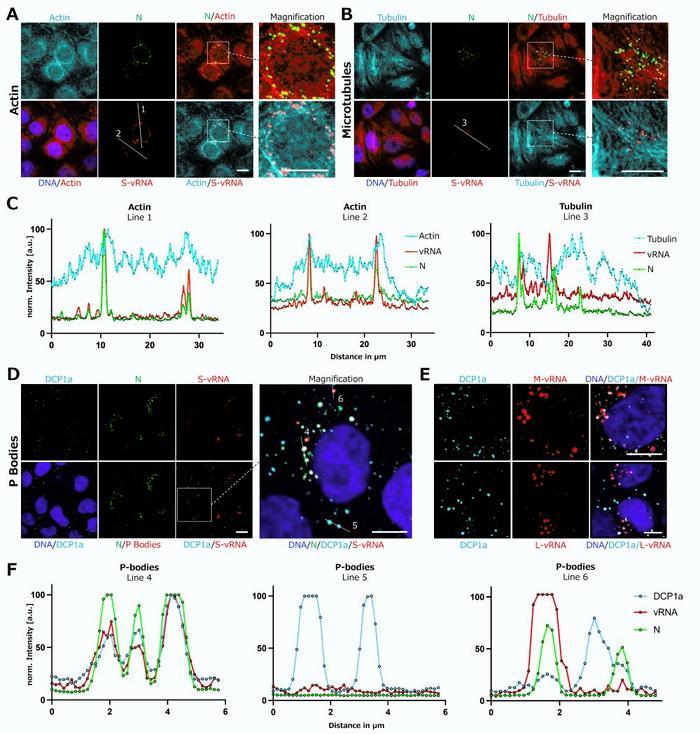
"Following infection with the Puumala virus, the architecture of the host cell undergoes profound changes: the number of RNA processing centers, so-called P-bodies, increases significantly and they relocate toward the cell periphery," explains Dr. Roland Schwarzer, co-author and researcher at University of Duisburg-Essen. "At the same time, parts of the cytoskeleton—actin filaments and microtubules—are strongly reorganized and now appear more prominently around the cell nucleus."
While the restructure of the host cell may help the virus exploit its infrastructure for its replication, the authors speculate that the changes in P-bodies could also represent a counter-strategy by the host cell to degrade viral RNA.
The results significantly advance our understanding of how orthohantaviruses influence the internal architecture of their host cells. In the long term, these insights could help identify new targets for antiviral therapies.
NOTES FOR EDITORS
The paper “Remodelling of P-bodies and the cytoskeleton by Orthohantavirus puumalaense (Puumala virus)” by Hannah Sabeth Schwarzer-Sperber, Annette Petrich, Matthias Schade, Niklaas Nilson, Linah Chibrac-Ahad, Maik J. Lehmann, Katharina Paulick, Sabrina Weiss, Tina Dluzak, Daniel Bourquain, Peter T. Witkowski, Detlev H. Krüger, Andreas Herrmann and Roland Schwarzer, is published in the Journal of General Virology under the following:
DOI: https://doi.org/10.1099/jgv.0.002220
URL: https://www.microbiologyresearch.org/content/journal/jgv/10.1099/jgv.0.002220
For further information, please contact [email protected]
Image: Schwarzer-Sperber et al. (2026)