Strong biofilm-forming capabilities observed among Salmonella isolates from poultry production facilities
Salmonella is responsible for substantial numbers of individual cases and outbreaks of foodborne human gastrointestinal disease, despite monitoring and controls at many levels of the food chain. Poultry products can be implicated in transmitting salmonellosis. Cleaning, disinfection and sanitisation are key parts of strategies for suppressing and eliminating Salmonella from poultry production, but biofilms are important barriers to the effectiveness of such measures.
Biofilms are communities of microorganisms that are embedded within a self-produced multi-component extracellular matrix. They form at interfaces between different phases in their physical environment (solid/air, solid/liquid, liquid/air). They are a fascinating microbiological adaptation to aid survival in potentially hostile environments. Biofilms vary in physiochemical characteristics, according to the microorganism, and their formation is triggered by environmental factors. Multi-species biofilm communities are common. The stabilising and protective benefits of biofilms allow organisms to persist and often flourish, both in environments where they may be useful to us (such as waste treatment plants) and where they are unwanted – such as on the surfaces of medical devices and implants or in animal production facilities.
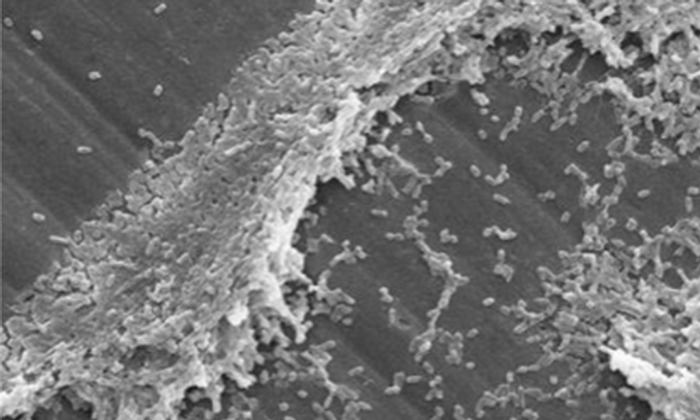
The ability to form a biofilm, and the conditions under which this is optimally expressed, differ between bacterial isolates, and Salmonella is no exception. For cleaning, disinfection and other control strategies it is useful to know how prevalent a strong biofilm capability is among Salmonella isolates from poultry facilities, and what factors (for example, serotype, facility type, surface) may correlate with this. An archived set of Salmonella isolates from poultry environments presented us with an excellent opportunity to investigate this in a resource-efficient manner.
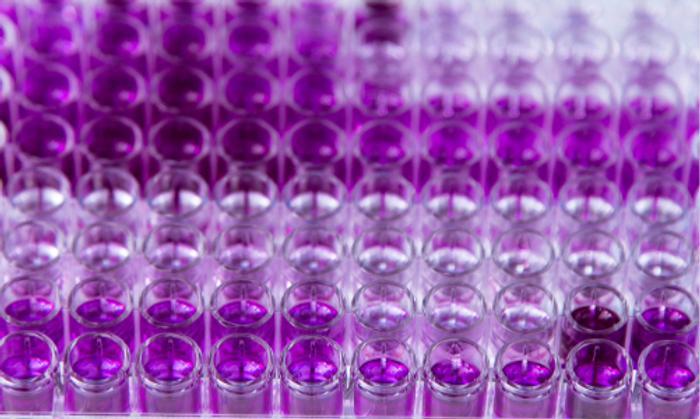
Problems with objective biofilm assessment include the subtle and multiple variations in biofilm formation according to local physical and chemical conditions, also accurately quantifying the amount of biofilm formed. To screen biofilm formation abilities, we employed a previously described crystal violet microtitre plate assay where the interface (polystyrene microtitre plate/broth growth medium) and detection method (crystal violet dye staining of the biofilm with subsequent quantification using optical density measurement) were simple and repeatable, and lent themselves to multiple replicates. Other key factors, including time and temperature of incubation were precisely controllable. We selected incubation temperatures of 20 °C and 25 °C, as these likely reflected conditions from the source environments and furthermore were in a range that had not much been investigated in laboratory biofilm investigations of Salmonella.
The source environments of the 96 isolates investigated were quite diverse, encompassing chicken, duck and turkey species, and varied facilities including feed mills, hatcheries, egg-laying farms and meat bird production. Perhaps unsurprisingly for environmental isolates, nearly all the isolates did form biofilm, although there were differences in the speed at which this happened. There were significant correlations between the amount of biofilm formed and both higher temperature and longer incubation time (72 hours vs. 48 hours), although this was not a uniform finding for all isolates.
This work was a survey of several serotypes from varied sources. The observed biofilm formation ranged from none, through poor and moderate, to strong. Most isolates (about four-fifths) strongly produced biofilm under at least one of the four test combinations of time and temperature. However, only around half of the isolates showed strong biofilm formation under all test conditions. This combination of prevalent strong biofilm potential but varied expression suggests that, whereas biofilm formation by Salmonella may be rather responsive to environmental conditions, isolates colonising poultry production environments typically do have a strong biofilm-forming capability under certain conditions. It seems wise for cleaning and disinfection programmes to take account of this.
The assay used in the study lends itself to modifications for further investigation of Salmonella strain responses to, for example, nutrient stress, duration and temperature. The ability of the crystal violet microtitre plate technique to screen many isolates simultaneously is a considerable advantage when examining field isolates that are varied in respect of serotype, sample type, poultry species and production premises.
Micro Scopes
Micro Scopes is an ongoing blog series by the Microbiology Society, written by microbiologists. This series brings you the latest and most exciting scientific findings published in the Society's journals and spotlights the perspectives of microbiologists around the world on their latest research.