The Copper Economy of Candida-Bacteria Mixed Biofilms
What is your name, job title and institution?
Dr Seána Duggan is a Research Fellow at the MRC Centre for Medical Mycology (MRC CMM) at the University of Exeter.
Tell us a little bit about your research and why it is important
My lab investigates how the microbes that cause co-infections interact with each other. I decided to investigate Candida albicans and Staphylococcus aureus interactions having studied both organisms individually at different stages of my career. These microbes belong to different biological kingdoms; the former is a fungus and the latter a bacterium, but they have a lot in common. They are both part of the healthy human microbiome and they can both cause disease when they get the opportunity. Given these microbes are, individually, leading causes of disease worldwide and occur naturally in many of the same areas of the human body, I think it's important we understand how they interact in different contexts of human health and disease.
We often think of fungi and bacteria as quite different – which is true. But they have many things in common in terms of how they cause disease. One shared feature is that both microbes can form biofilms – groups of microbes stuck to each other and often to a surface such as a breathing tube or human tissue. Biofilm-associated infections are particularly difficult to treat and carry a substantial healthcare burden. These sticky structures became the focus of our paper.
Why did you decide to investigate this hypothesis?
We, and others before us, observed that biofilms formed from C. albicans and S. aureus were bigger and stronger than biofilms formed of either single species under the same conditions. I wanted to understand the basis of the cooperative interaction between these pathogens.
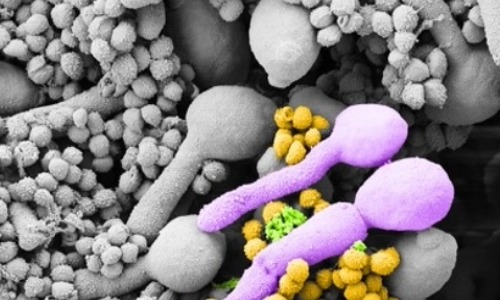
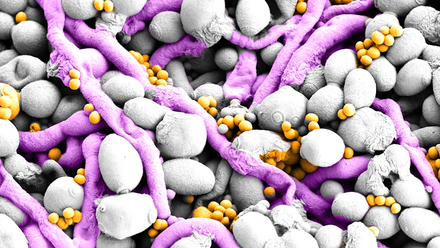
Candida albicans and Staphylococcus aureus mixed biofilm. This is a scanning electron microscopy image with some C. albicans false coloured in purple, some S. aureus false coloured in gold, and some matrix false coloured in green, all on a grey scale image. Credit: Christian Hacker and Seána Duggan.
Tell us about your most recent paper
In our paper, we investigated how C. albicans and S. aureus cooperate in mixed biofilms.
We first compared mixed biofilms with biofilms formed by either organism alone. The mixed biofilms were larger and more metabolically active, suggesting that both organisms benefited from growing together. To understand what might drive this cooperation, we used proteomics to identify proteins that changed during mixed growth.
This revealed a striking difference in copper handling: C. albicans increased proteins involved in copper uptake as well as copper-dependent proteins, while S. aureus increased proteins associated with copper export and copper stress protection. At first, this seemed counterintuitive. Why would two organisms in the same biofilm respond to copper in opposite ways? This became the central clue. We began to think of the mixed biofilm as having a 'copper economy', where the two organisms manage a resource in a way that supports the community. Experimentally, we changed copper availability in the biofilm cultures and found that both copper excess and copper limitation disrupted the cooperative biofilm, even at concentrations that had little or no effect on single-species biofilms. This showed that cooperation depended on copper being maintained within a permissive range. Fungal copper import was also important. When the C. albicans copper transporter Ctr1 was absent, the mixed biofilm lost its cooperative advantage. By testing C. albicans with a range of pathogenic bacteria, we found that copper import may influence several fungal-bacterial interactions.
Together, our findings suggest that copper is not just a toxic metal that microbes must survive. In mixed biofilms, copper can help pathogens cooperate.
Was there a moment you remember it all ‘coming together’?
Yes – when we first received the proteomics data, it was actually a bit frustrating. There was a lot to untangle because we were not just asking what changed in one organism. We had to understand what was happening in both organisms at the same time. I explained the frustration to my husband, who is also a scientist, and as I talked it through, the copper story suddenly started to make sense. The fungus was behaving as though it needed copper, while the bacterium was behaving as though it needed to get rid of it. That difference was not noise – it was the clue! I also remembered a previous paper showing that a copper-sensing protein was involved in C. albicans and S. aureus biofilms. That helped connect our data to a broader biological context. It was one of those moments where several separate observations suddenly arranged themselves in my thinking – forming a preliminary version of the model we have now.
What was the research process like? Do you have any standout memories of the experience?
One of my standout memories was presenting the early data at the Candida and Candidiasis meeting in Montreal, Canada. At that meeting, I met Roberto Vazquez-Muñoz, who is an author on the paper. He had been working on related questions and had observed similar effects of copper treatments on C. albicans and S. aureus biofilms. That was a really important moment. It was validating to learn that, using different approaches and working an ocean apart, we were seeing similar biology. It gave us confidence that the copper-dependent effects we were observing were important.
The project also benefited from a very collaborative team. The study brought together microbiology, proteomics, data science, imaging, clinical practice and biofilm biology. This exact team was essential because the story was not visible from one type of experiment alone.
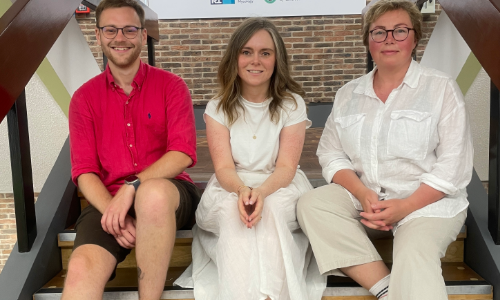
Team MRC CMM: Authors from MRC CMM, University of Exeter who contributed to the study. From left to right, Orlando Ross, Seána Duggan and Iana Kalinina. Credit: Charlie Holt, Orlando Ross, Iana Kalinina, Seana Duggan.
What do you hope the future implications of this research will be?
I hope our work contributes to the shift emerging in how we think about co-infections. Rather than treating them as the sum of two separate pathogens, we need to understand the new biology that emerges when microbes grow together. Our study suggests that micronutrients can act as tipping points in clinically relevant microbial communities. Understanding these vulnerabilities could help identify new approaches for polymicrobial infections, by disrupting the relationships between pathogens.
Why should we be excited about the future of your research area?
We’re at an exciting juncture for microbial interaction research, because we now have the tools to study microbial communities in much greater detail and can ask how individual and community-level behaviours intersect. There is still a lot we don’t understand. Why do some microbial partnerships become cooperative while others become competitive? How is resilience built in microbial communities? How do host factors, such as immune responses, change the outcome of these interactions? These are important questions for infection biology, antimicrobial resistance and biofilm research.
The field is especially exciting because it brings different communities together. To understand polymicrobial infections, we need all types of microbiologists, immunologists, clinicians, microscopists, chemists, computational biologists… the list goes on. That makes the research itself challenging, but it makes the process more creative and collaborative.
For me, the most exciting idea is that microbial communities may have hidden vulnerabilities that are only visible when we study the relationships between organisms. If we can identify the conditions that make harmful partnerships fail, we may be able to find new ways to disrupt infections that are currently very difficult to treat.
Micro Scopes
Micro Scopes is an ongoing blog series by the Microbiology Society, written by microbiologists. This series brings you the latest and most exciting scientific findings published in the Society's journals and spotlights the perspectives of microbiologists around the world on their latest research.