The pQBR collection: a model set of co-occurring environmental plasmids
Plasmids, and other mobile genetic elements (MGEs), are an integral part of microbiome evolution and adaptation. Most of our knowledge surrounding plasmid ecology and evolution comes from clinical plasmids after the widespread introduction of antibiotics. With MGEs driving spread of resistance traits worldwide and with attempts being made to adapt them for therapeutics and microbiome engineering, it is vital we understand their evolutionary mechanisms from a wider reference pool, including environmental plasmids.
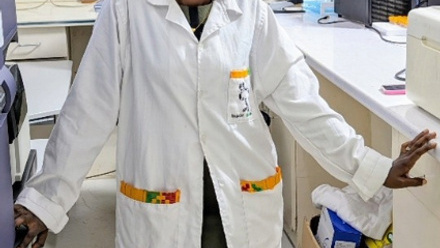
My name is Dr Victoria Orr, I am a postdoctoral research associate with Dr James Hall at the University of Liverpool. My research interests centre around MGE evolution and ecology, particularly plasmids and transposable elements, combining both computational and laboratory-based methodologies.
This work began during my PhD, titled “How do interactions between plasmids and transposons affect resistance trait spread?”. Plasmids, mostly found as circular extrachromosomal DNA, can horizontally transfer between bacterial hosts via conjugation, carrying within them a cargo of genes, such as antibiotic resistance genes. These cargo genes are frequently encoded on transposable elements, genes which can “jump” between the plasmid and chromosome via transposition.
Starting with four plasmids, pQBR57, pQBR103, pQBR55 and IncP-2 plasmid p1 from Pseudomonas koreensis strain P19E3 (pP19E3.1), we aimed to see if we could predict the ability of a plasmid to transfer a chromosomal transposon from donor to recipient host based on the plasmid’s conjugation rate or fitness cost. Within a few months, we’d optimised a protocol to compare plasmid conjugation rate to the plasmid’s ability to carry a transposon from the chromosome of the donor to the recipient strain.
This process first involving the transposon undergoing transposition onto the plasmid from the donor chromosome, and subsequently horizontally transferring with it into the recipient via conjugation. By November 2022, the protocol had yielded preliminary results which we were discussing with Dr Damian Rivett at the Microbiology Society event, ‘Understanding and Predicting Microbial Evolutionary Dynamics’. He offered to provide us with the rest of the pQBR plasmid collection, enabling us to open up the project further and extend our experimental panel to compare within and between groups of genetically distinct plasmids.
The pQBR collection are environmental plasmids, isolated from the phytosphere of sugar beets at Oxford University Farm in the 1990s. Four of these plasmids have been previously sequenced and characterised by Dr James Hall, most prominently pQBR57 and pQBR103. These two plasmids have been involved in several plasmid evolution-ecology studies, for example, focussing on plasmid fitness cost and compensatory mutations.
Combining bioinformatics with experimental work, we have sequenced and characterised the collection, expanding it from 4 to 26 sequences. These plasmids form 6 distinct genetic groups and are generally large (140–588 kb). They contain a variety of putative defence systems and toxin-antitoxin systems. No known AMR genes were detected within the sequences. Within the 6 genetic groups, there was high nucleotide level sequence conservation, with most structural variation due to transposable element activity, highlighting their role in driving rapid plasmid evolution.
This work formed the second chapter of my thesis, which I completed in 2025, and presented at several meetings, including winning the Microbiology Journal Poster Prize at the Microbiology Society Annual Conference in the same year. There were still many questions running through our minds after my thesis submission and we planned to expand our bioinformatical approach to the collection.
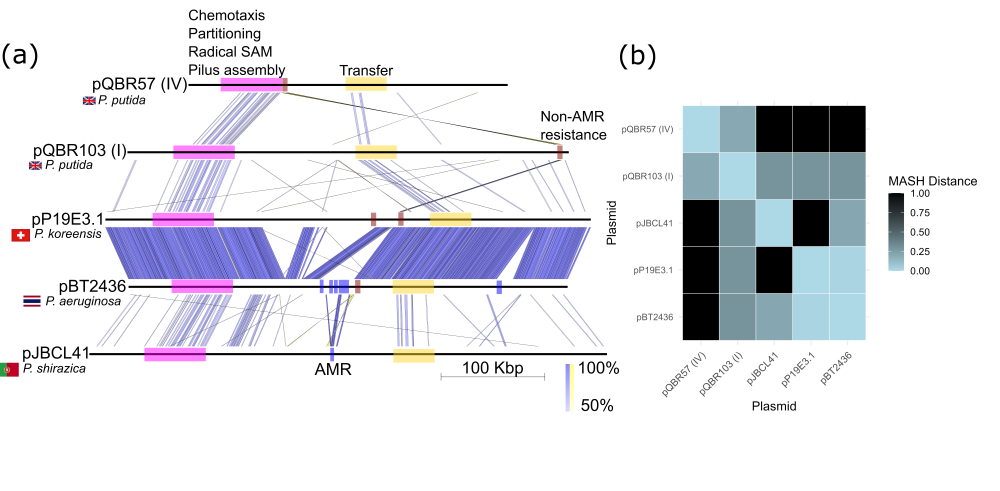
After graduating from my PhD, we continued our pQBR exploration by comparing the plasmid sequences to public databases. We found plasmid relatives worldwide from both clinical and environmental settings. When comparing plasmids pQBR57 (Group IV) and pQBR103 (Group I), we found that despite high nucleotide divergence, when comparing the translated protein sequences, there were significant regions encoding the same functional proteins in the same order. We believe this constitutes an ancient plasmid backbone that has diversified at the nucleotide level, and it is shared with several IncP-2 multi-drug-resistant plasmids, including pP19E3.1. Additionally, as well as proteins that are typically associated with plasmid “core” functions, such as partitioning and replication, these backbones encoded a chemotaxis phosphorelay system and radical SAM-metabolizing enzymatic clusters, highlighting that plasmids are not just shuttles for resistance genes but may have other key functionality.
Given the interest received and connections made at Microbiology Society meetings, we decided to publish with Microbial Genomics, wanting this work to be open-access and a way to give back to the Society. We wanted to provide a comprehensive resource for future studies using this interesting collection of co-occurring plasmids that can be used to mimic pre-AMR conditions.
Further work utilising this collection that is in preparation for publication now, includes comparing how the transposability of resistance traits can influence trait and plasmid maintenance in an evolution experiment and using plasmid data from pQBR57 and pQBR103 to feed into an agent-based model comparing how plasmid features, transposition rate and environmental selection interact to affect resistance trait spread and MGE dynamics.
There is much still to discover, and we welcome any interest in utilising this collection!