The (Un)Successful Global Spread of Acinetobacter baumannii Sequence Type 3
Some bacteria seem to have all the right genetic material for success. They can survive in hospitals, resist important antibiotics and exchange DNA with other bacteria. Yet, surprisingly, not every bacterial strain with these genetic material and traits becomes globally widespread.
This was the question that led our team to investigate Acinetobacter baumannii sequence type 3, or ST3.
I am Associate Professor Mehrad Hamidian, a microbiologist and researcher at the Australian Institute for Microbiology and Infection (AIMI), University of Technology Sydney, Australia. My research focuses on antimicrobial resistance, bacterial genomes and, particularly, how bacteria acquire and exchange genetic material that can help them survive antibiotic treatment.
This project grew out of the work of my PhD student, Eradah Abu Sabah, who led the genomic analysis as part of her doctoral research. The project also brought together collaborators Dr. Margaret M. C. Lam (Monash University, Melbourne, VIC, Australia), Dr. Francois Lebreton and Dr. Patrick T. McGann, from Walter Reed Army Institute of Research, Silver Spring, MD, USA, whose expertise and access to the Military-Relevant Antimicrobial Resistance Network data were important to the study. The collaboration brought together researchers across institutions, allowing us to examine ST3 from both an evolutionary and epidemiological perspective.
First, we asked a simple question: why can a bacterial lineage spread widely without becoming globally dominant?
Acinetobacter baumannii is an opportunistic pathogen and a major cause of difficult-to-treat infections, particularly in hospitals. Its global importance is reflected in its inclusion on the World Health Organization’s bacterial priority pathogens list, where drug-resistant A. baumannii is recognised as a critical priority pathogen of public health concern. Numerous studies have shown that a small number of clones, including ST1 and ST2, have spread extensively worldwide and accumulated many antibiotic resistance genes.
ST3, however, tells a different story! ST3 is geographically widespread. We can find it in many countries (Figure 1) and across different clinical and non-clinical settings (Figure 2), but it has never achieved the same level of global dominance as some of its relatives. We therefore wanted to understand why.
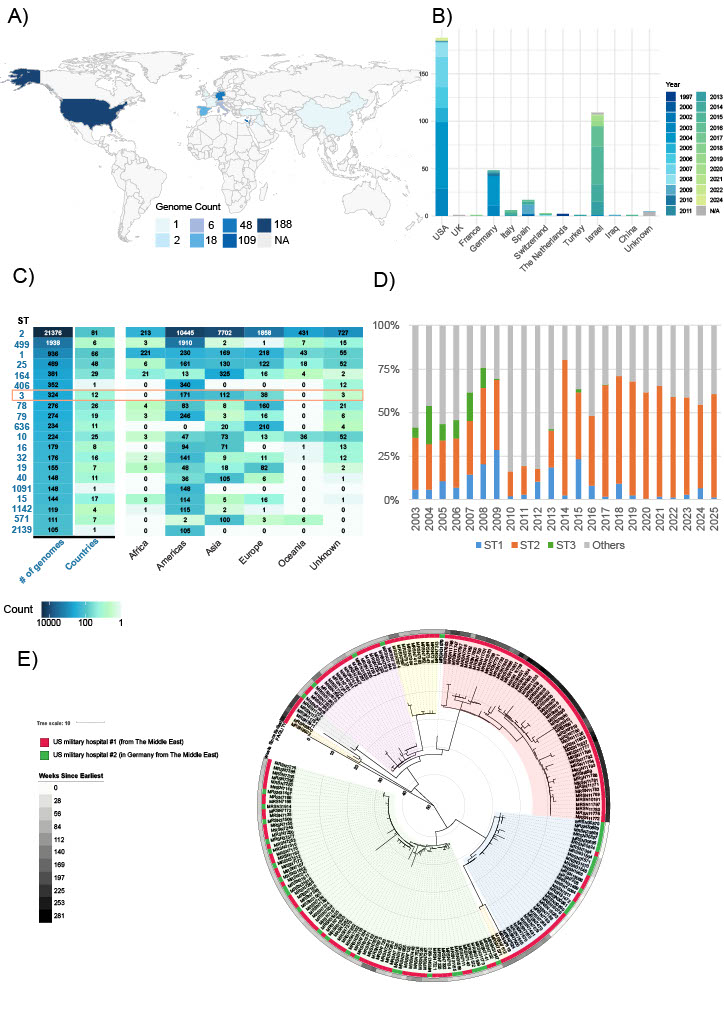
To investigate this, we studied 383 ST3 genomes that included genomes generated through the Military-Relevant Antimicrobial Resistance Network and all publicly available genomes. This gave us an opportunity to look at ST3 not as a single bacterial strain, but as a population that has evolved over many years and across different parts of the world (Figure 3).
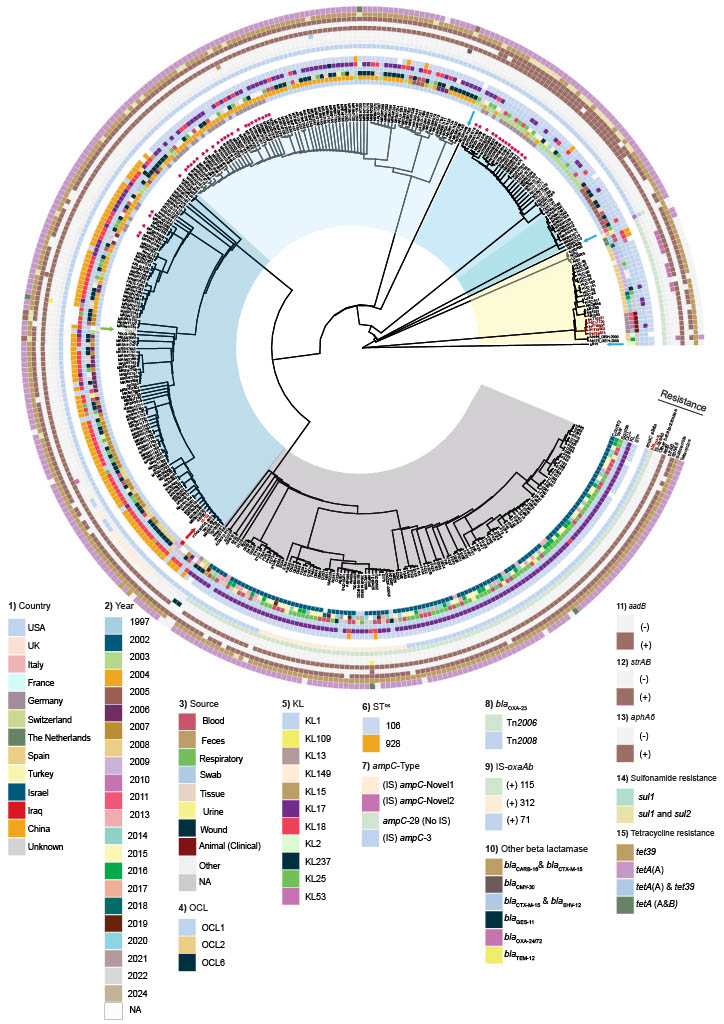
First, we found a strong connection with the Middle East. More than 80% of the genomes were either collected in Middle Eastern countries or were associated with the region, suggesting that the lineage may have been established there and that the region could represent an important reservoir for ST3.
But the interesting part came when we looked at how ST3 had evolved.
Bacteria do not always evolve simply by accumulating mutations in their own DNA. They can also acquire pieces of DNA from other bacteria (through a known genetic mechanism called Homologous Recombination). Our analyses revealed that ST3 had exchanged large sections of its chromosome DNA with other A. baumannii lineages, including the major globally distributed clones ST1 and ST2.
In other words, ST3 has been interacting genetically (i.e. exchanging genetic material) with its relatives and picking up pieces of their DNA.
This raised an obvious question: if ST3 is capable of acquiring genetic material from successful lineages, why hasn't it become equally successful?
One possible answer emerged when we looked at DNA associated with antibiotic resistance.
Compared with ST1 and ST2, ST3 carried considerably fewer acquired antibiotic resistance genes. On average, ST3 genomes carried approx. five acquired resistance genes, compared with ten in both ST1 and ST2 (Figure 3). ST3 was certainly not antibiotic-sensitive, but its resistance repertoire was much more limited.
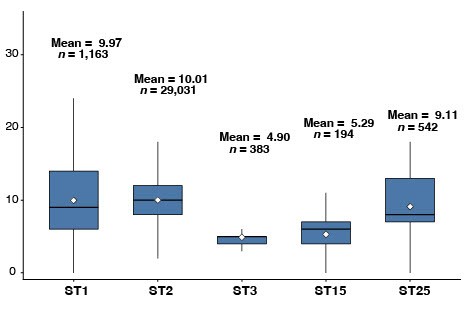
We also found that ST3 had a dynamic region in its chromosome associated with resistance. Almost all of the genomes carried a version of a resistance island approximately 19 kilobases long, which we called AbST3GRI. Different versions had gained or lost DNA through the activity of mobile genetic elements, suggesting the continual evolution of this region. However, variants of AbST3GRI only included resistance genes that confer to older antibiotics such as tobramycin, tetracycline and sulfonamides unlike other major global clones that carry resistance genes that often confer resistance to last resort antibiotics such as carbapenems or colistin.
Plasmids added another layer of complexity to gene exchange events. These small DNA molecules can move between bacteria and often carry antibiotic resistance genes. We observed multiple plasmid types and considerable variation in their genetic content among ST3 isolates. Additionally, rearrangements and exchanges of genetic modules were observed in some plasmids, providing another example of just how fluid bacterial genomes can be.
So ST3 is clearly capable of genetic change. It can acquire resistance genes, exchange chromosomal DNA and carry diverse plasmids. It also retains most (not all) of the virulence-associated genes we examined. And yet, it has not become a globally dominant clone. That is what makes ST3 an interesting lineage!
Our study suggests that bacterial success is not simply about possessing one advantageous gene or being able to survive antibiotics. Global spread probably depends on a combination of factors, including resistance, genome plasticity, ecology, transmission and the ability to persist in particular environments.
For our team, one of the most interesting outcomes of this project was that studying a lineage that hasn't become globally dominant can tell us something that studies of successful clones alone cannot. ST3 gives us a natural comparison of a bacterium that has many of the characteristics associated with successful A. baumannii lineages but has not followed the same evolutionary trajectory.
The work also highlights why large genomic datasets are so valuable. No single ST3 genome could have revealed this story. It emerged only when our team brought together hundreds of genomes and looked at their relationships, resistance genes, mobile genetic elements and evolutionary history.
ST3 may not have dominated the world, but its genome tells us that it certainly tried some of the same tricks as its more successful relatives (e.g. ST1 and ST2). In microbiology, the more revealing question is sometimes not “why did this bacterium succeed?” but “why didn’t it?” Therefore, to understand how AMR emerges and evolves in problematic lineages, we need to examine not only the clones that dominate, but also those that nearly or have not yet succeeded. In those unfinished success stories, we may find the hidden barriers that shape bacterial evolution and prevent success.
Micro Scopes
Micro Scopes is an ongoing blog series by the Microbiology Society, written by microbiologists. This series brings you the latest and most exciting scientific findings published in the Society's journals and spotlights the perspectives of microbiologists around the world on their latest research.